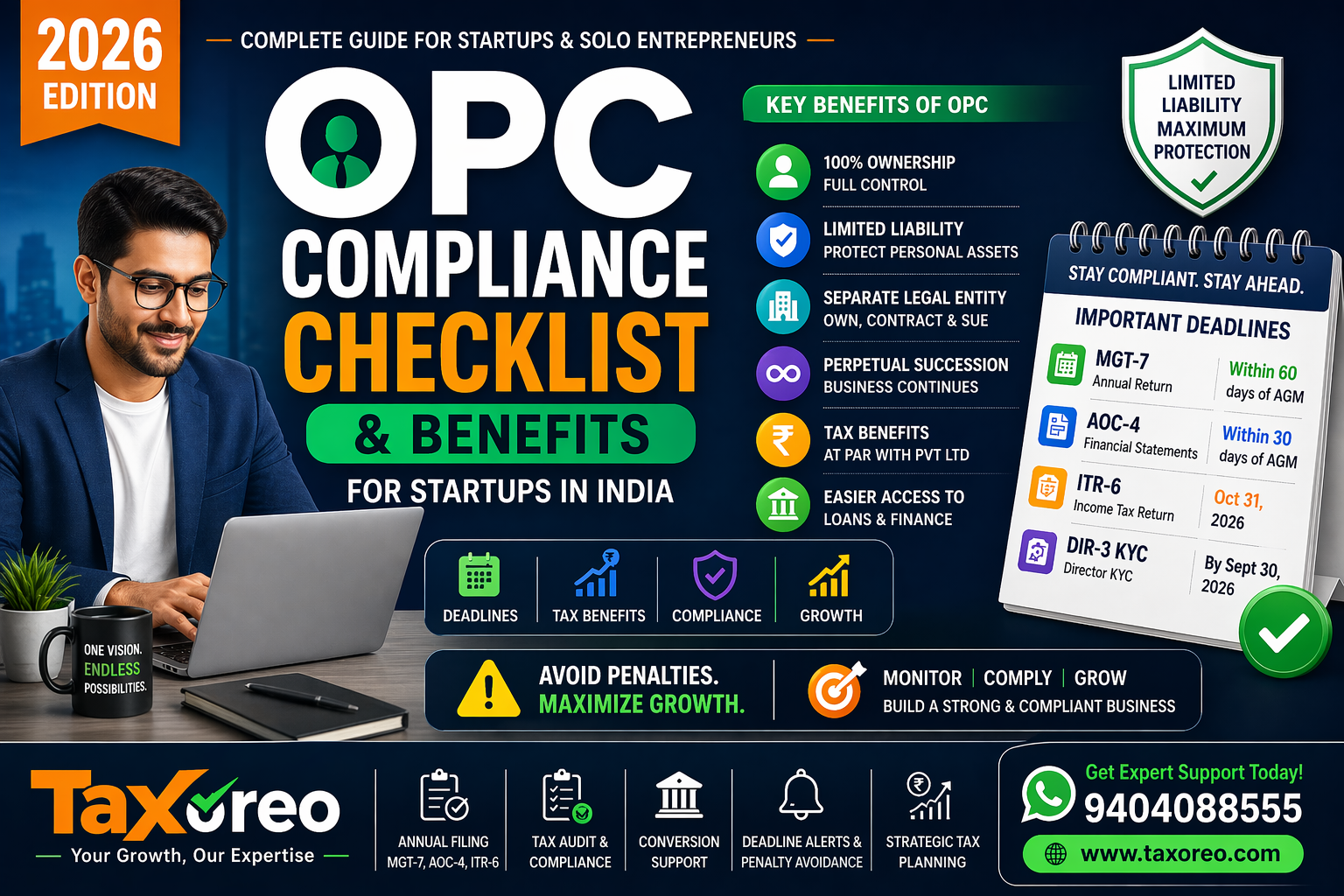
One Person Company (OPC) Compliance Checklist & Benefits for Startups in India 2026
Executive Summary: Why Compliance & Benefits Matter
• Critical Deadlines for FY 2025-26: Annual Return (Form MGT-7) due within 60 days of AGM; Financial Statements (Form AOC-4) due within 30 days of AGM; Income Tax Return (ITR-6) due October 31, 2026 (if audit applicable)
• Key Benefits: 100% ownership control, limited liability protection, separate legal entity status, perpetual succession, easier loan access compared to proprietorship, and tax benefits at par with private companies
• Tax Structure: Flat 25% tax rate (if turnover ≤₹400 crore) + 4% Health & Education Cess = Effective rate of 26%; presumptive taxation available under Section 44AD for eligible OPCs
• Mandatory Conversion Trigger: OPC must convert to Private Limited Company if paid-up capital exceeds ₹50 lakh or turnover exceeds ₹2 crore (based on average of preceding 3 financial years)
• Professional Support: For compliance management, tax planning, and conversion services, expert assistance is available at Taxoreo (www.taxoreo.com) or via WhatsApp at 9404088555
Key Benefits of Choosing an OPC Structure
Strategic Advantages:
- 100% Ownership Control: Make all business decisions independently without shareholder approvals
- Limited Liability Protection: Personal assets are shielded from business liabilities and debts
- Separate Legal Entity: OPC can own property, enter contracts, sue, and be sued in its own name
- Perpetual Succession: Business continues via nominee even if the sole member passes away
- Enhanced Credibility: Corporate structure builds trust with clients, vendors, and financial institutions
- Easier Access to Finance: Banks and NBFCs prefer lending to registered companies over proprietorships
- Tax Parity with Private Companies: Same corporate tax rates and deductions available
- Simplified Governance: Exempt from holding Annual General Meeting (AGM) under Section 96
Ideal Use Cases:
- Freelancers and consultants seeking professional credibility
- Professionals (CA, architects, designers) wanting liability protection
- Solo entrepreneurs testing business concepts before scaling
- Individuals with moderate-risk businesses requiring asset protection
- Business owners planning future conversion to Private Limited Company
Tax Structure & Financial Advantages
Corporate Tax Framework (FY 2025-26):
- Base Rate: 25% (for turnover ≤₹400 crore)
- Health & Education Cess: 4% on tax amount
- Effective Tax Rate: 26% (25% + 4% cess)
- Presumptive Taxation: Eligible OPCs can opt for Section 44AD (declare 50% of turnover as profit)
Additional Tax Benefits:
- Deductions for business expenses (rent, salaries, professional fees, travel)
- Depreciation benefits on capital assets
- Director remuneration deductible under Section 40(b) of Income Tax Act
- Carry-forward of losses (subject to audit compliance)
- Input Tax Credit availability under GST (if registered)
Dividend Distribution:
- Post-tax profits can be distributed as dividends to the sole member
- Dividends taxable in hands of member at applicable slab rates
- No Dividend Distribution Tax (DDT) since FY 2020-21
Compliance Timeline at a Glance
|
Time Period |
Requirement |
Required Action |
|
Upon Incorporation |
Certificate of Incorporation issued with CIN |
File Form INC-22 within 30 days for registered office verification |
|
First Financial Year |
Mandatory conversion triggers |
Convert to Pvt Ltd if paid-up capital >₹50L or turnover >₹2 crore |
|
Annually (Every FY) |
OPC existence is perpetual |
File Annual Return (MGT-7) within 60 days of AGM; Financial Statements (AOC-4) within 30 days of AGM |
|
Income Tax |
PAN allotted at incorporation |
File ITR-6 by October 31 (if audit applicable under Section 44AB) |
|
Director KYC |
DIN validity |
File DIR-3 KYC annually between April 1 – September 30 |
|
Board Meetings |
Minimum compliance |
Conduct at least one board meeting in each half of calendar year (gap ≥90 days) |
Critical Warning: Failure to file annual returns (MGT-7/AOC-4) attracts Additional Fees under the Companies (Registration Offices and Fees) Amendment Rules, 2022. Delays beyond 360 days can result in fees up to 12 times the normal filing fee. Persistent non-compliance may lead to the OPC being struck off the register under Section 248 of Companies Act, 2013.
Annual Compliance Requirements & Consequences
|
Requirement |
Specific Deadline |
Consequence of Default |
Penalty/Interest Reference |
|
Annual Return (Form MGT-7) |
Within 60 days of AGM (typically by November 28 for FY ending March 31) |
Additional fees under slab system (1x to 12x based on delay); director disqualification risk |
Section 92(4) Companies Act; Rule 12 of Companies (Management & Administration) Rules |
|
Financial Statements (Form AOC-4) |
Within 30 days of AGM (typically by October 29 for FY ending March 31) |
Additional fees; potential prosecution of directors; imprisonment up to 6 months in extreme cases |
Section 137 Companies Act; Section 448 for false statements |
|
Income Tax Return (ITR-6) |
October 31 (if audit applicable under Section 44AB) |
Interest u/s 234A (1% p.m. on unpaid tax); penalty u/s 271F up to ₹10,000; loss carry-forward denied |
Income Tax Act, 1961 |
|
Tax Audit (if applicable) |
September 30 (report filing); October 31 (ITR filing) |
Disallowance of expenses; penalty u/s 271B up to 0.5% of turnover or ₹1,50,000 (whichever is lower) |
Section 44AB Income Tax Act |
|
DIR-3 KYC for Director |
September 30 annually |
DIN marked "Deactivated"; ₹5,000 penalty for reactivation; inability to file forms |
MCA General Circular No. 10/2023 |
|
Board Meetings |
At least one meeting in each half of calendar year (gap ≥90 days) |
Penalty up to ₹25,000 on company; ₹5,000 on every officer in default |
Section 173 Companies Act |
|
Mandatory Conversion |
Within 6 months of exceeding thresholds (turnover >₹2Cr or capital >₹50L) |
Penalty up to ₹10,000 plus ₹1,000 per day of default; compulsory conversion by ROC |
Rule 6 of Companies (Incorporation) Rules, 2014 |
Key Compliance Management Notes
• Payment Windows: Additional fees for delayed filings are calculated based on the period of delay; small companies (paid-up capital ≤₹50 lakh, turnover ≤₹2 crore) enjoy reduced fee slabs under Companies Amendment Act, 2021
• AGM Exemption: OPC is exempt from holding Annual General Meeting (AGM) under Section 96; however, board resolutions must be recorded in minutes book within 30 days
• Documentation: Maintain digital and physical copies of all filed forms, acknowledgments, financial statements, and board resolutions for minimum 8 years
• Extensions: No statutory extensions for MCA filings; income tax deadlines may be extended via CBDT notifications
• Audit Requirement: Unlike Private Limited Companies (which have audit exemptions for small companies), OPCs must conduct statutory audit irrespective of turnover or business activity
Comparative Analysis: OPC vs Sole Proprietorship vs Private Limited Company
|
Parameter |
One Person Company (OPC) |
Sole Proprietorship |
Private Limited Company |
|
Minimum Members |
1 Member (mandatory nominee) |
1 Owner |
2 Shareholders |
|
Liability |
Limited to share capital |
Unlimited (personal assets at risk) |
Limited to unpaid share value |
|
Compliance Burden |
Moderate: MGT-7, AOC-4, ITR-6, Board Meetings |
Low: GST, ITR-4, basic licenses |
High: MGT-7, AOC-4, Board Meetings, AGM, multiple filings |
|
Audit Requirement |
Mandatory irrespective of turnover |
Only if turnover >₹1 crore (tax audit) |
Mandatory irrespective of turnover |
|
Tax Rate |
25% + cess (if turnover ≤₹400Cr) |
Individual slab rates (up to 30%) |
25% + cess (if turnover ≤₹400Cr) |
|
Credibility |
High (corporate structure) |
Low (unregistered entity) |
Very High (preferred by investors) |
|
Fundraising |
Moderate (debt easier, equity complex) |
Difficult (limited to personal funds/loans) |
Easy (equity dilution, VC/PE funding) |
|
Perpetual Succession |
Yes (nominee takes over) |
No (business ends with owner) |
Yes (separate legal entity) |
|
FDI Permission |
Not permitted (Indian citizens only) |
Permitted in proprietorship |
100% automatic route in most sectors |
Real-World Impact Analysis: Tax & Working Capital Example
Scenario: A freelance consultant with ₹80 lakh annual turnover and ₹10 lakh business expenses.
OPC Structure:
- Gross Income: ₹80 lakh | Business Expenses: ₹10 lakh | Net Profit: ₹70 lakh
- Corporate Tax: ₹70L × 25% = ₹17.5L + 4% cess = ₹18.2L effective tax
- Post-tax profit available: ₹51.8L (can be withdrawn as dividend, taxable in member's hands)
- Compliance Cost: ~₹25,000/year (professional fees for MGT-7, AOC-4, ITR-6, audit)
- Working capital retained: ₹51.55L
Sole Proprietorship Structure:
- Same Net Profit: ₹70 lakh
- Tax (assuming 30% slab + cess): ₹21.84L effective tax
- Presumptive taxation option (Section 44AD): If eligible, declare 50% of turnover as profit = ₹40L deemed profit; tax = ₹12.48L (significant savings)
- Compliance Cost: ~₹5,000/year
- Working capital retained: ₹57.47L (with presumptive taxation)
Strategic Decision Framework:
Choose Proprietorship if: Turnover <₹2 crore, low-risk business, prioritizing tax efficiency via presumptive taxation
Choose OPC if: Need credibility, carry professional risk, plan to scale, want liability protection
Choose Pvt Ltd if: Planning equity funding, multiple founders, or high-growth startup trajectory
The ₹5.72L additional tax in OPC vs presumptive proprietorship is essentially an insurance premium for asset protection and corporate credibility.
Common Compliance Mistakes & Prevention Strategies
|
Common Mistake |
Consequence |
Prevention Strategy |
|
Missing MGT-7/AOC-4 filing deadlines |
Additional fees up to 12x normal fee; director disqualification after 3 years of non-compliance |
Set calendar reminders 30 days before due dates; engage compliance service provider; use MCA portal alerts |
|
Ignoring mandatory conversion thresholds |
Penalty of ₹10,000 + ₹1,000/day; compulsory conversion by ROC; reputational damage |
Monitor turnover and capital quarterly; initiate conversion process 3 months before threshold breach |
|
Not maintaining proper books of accounts |
Penalty up to ₹5,000 under Section 128; audit complications; ITR rejection |
Use accounting software from day one; reconcile bank statements monthly; retain invoices for 8 years |
|
Filing INC-22 (registered office) late |
Additional fees; notice from ROC; potential strike-off proceedings |
File INC-22 along with SPICe+ or within 15 days of incorporation; keep rental agreement updated |
|
Assuming OPC doesn't need audit |
Penalty for non-filing of audited financial statements; ITR processing delays |
Remember: OPC audit is mandatory regardless of turnover; appoint CA within 30 days of incorporation |
Frequently Asked Questions: Compliance & Benefits Focus
Q1: What happens if the sole member of OPC dies? The nominee (named in Form INC-3 during incorporation) automatically becomes the new member of the OPC. Legal heirs can either continue the OPC through the nominee or convert it to Private Limited Company or dissolve it as per succession plans.
Q2: Can an OPC convert to Private Limited Company voluntarily? Yes. An OPC can voluntarily convert to Private Limited Company after 2 years from incorporation by filing Form INC-6. However, if turnover exceeds ₹2 crore or paid-up capital exceeds ₹50 lakh, conversion becomes mandatory within 6 months.
Q3: Is audit mandatory for OPC even with zero turnover? Yes. Unlike Private Limited Companies (which have audit exemptions for small companies), OPCs must conduct statutory audit irrespective of turnover or business activity. Nil returns must still be audited and filed.
Q4: Can an OPC have employees? Yes. An OPC can hire employees, pay salaries, deduct TDS, and comply with labour laws like any other company. The sole member can also draw salary as a director (subject to provisions in Articles of Association).
Q5: Can an OPC claim deductions for director remuneration? Yes. The sole member, if acting as director, can receive remuneration subject to provisions in the Articles of Association. Such remuneration is deductible business expense for the OPC under Section 40(b) of Income Tax Act.
Q6: Is GST registration mandatory for an OPC? Only if aggregate turnover exceeds ₹40 lakh (goods) or ₹20 lakh (services) in a financial year, or if engaged in inter-state supply/e-commerce. Voluntary registration is permitted for input tax credit benefits.
Latest Compliance Updates for FY 2025-26
- Conversion Threshold Clarification: Ministry clarified that the ₹2 crore turnover limit for mandatory conversion is based on average of preceding 3 financial years (not a single year), providing breathing room for fluctuating revenues
- Reduced Fees for Small OPCs: Companies (Registration Offices and Fees) Amendment Rules, 2022 introduced reduced fee slabs for OPCs with paid-up capital ≤₹50 lakh and turnover ≤₹2 crore
- Streamlined DIR-3 KYC: Annual KYC filing simplified with OTP-based verification; pre-filled data from previous years; bulk filing option for professionals managing multiple clients
- Enhanced Focus on Beneficial Ownership: OPCs must file Form BEN-2 if beneficial owner differs from registered member (rare for OPC but applicable in trust/nominee situations); non-compliance attracts penalties under Companies Act
Your OPC Compliance Calendar: Action Checklist
By September 30, 2026:
- File DIR-3 KYC for all directors (including sole member)
- Review nominee details and update Form INC-3 if changes needed
- Conduct second board meeting for FY 2025-26 (ensure 90-day gap from first meeting)
- Reconcile books of accounts and prepare trial balance
- Verify registered office details and update Form INC-22 if address changed
Quarterly/Periodic Tasks:
- Maintain proper books of accounts (cash book, ledger, trial balance, invoices)
- Reconcile bank statements with accounting records monthly
- File TDS returns (if applicable) quarterly by due dates (July 7, Oct 7, Jan 7, May 7)
- Conduct board meetings and record minutes within 30 days
- Monitor turnover and capital to track conversion thresholds
By October 31, 2026:
- Complete tax audit (mandatory for OPC) and obtain audit report
- File Income Tax Return (ITR-6) with audited financial statements
- File Form AOC-4 (Financial Statements) within 30 days of AGM exemption date
- File Form MGT-7 (Annual Return) within 60 days
- Pay advance tax installments if tax liability >₹10,000
Maximize Your OPC's Potential
Running a compliant, tax-efficient One Person Company unlocks credibility, protection, and growth opportunities that sole proprietorships cannot match. But staying on top of deadlines and regulatory changes requires expertise.
Let Taxoreo handle your OPC compliance so you can focus on growth:
- Annual filing management (MGT-7, AOC-4, ITR-6)
- Tax audit coordination & statutory compliance
- Conversion support when thresholds are crossed
- Proactive deadline alerts & penalty avoidance
- Strategic tax planning for optimal cash flow
Get expert support today:
WhatsApp: 9404088555