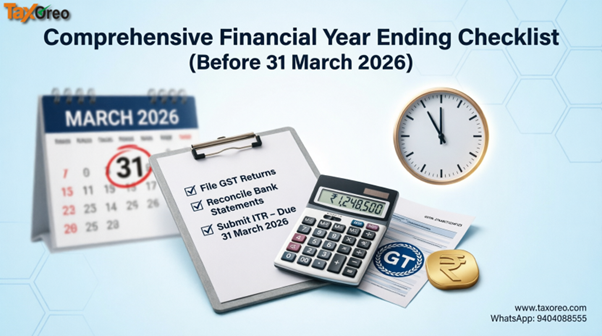
Comprehensive Financial Year Ending Checklist (Before 31 March 2026)
Financial Year: 2025-26 | Assessment Year: 2026-27
As the financial year draws to a close on 31 March 2026, businesses and individual taxpayers enter the most critical phase of the tax calendar. The decisions made and actions taken in these final days determine your tax liability, compliance status, and peace of mind during the audit season.
Missing key deadlines can lead to unnecessary interest, penalties, and lost tax-saving opportunities. Below is a detailed, actionable checklist to ensure you close your books efficiently and compliantly.
1. Accounting & Book Finalization
- The foundation of your tax return is your financial data. Inaccurate books lead to inaccurate tax filings.
- Update all sales & purchase entries: Ensure every invoice issued and received up to 31 March is recorded in your accounting software. Do not carry over March transactions to April.
- Record all expenses & income: Accrue all income earned but not yet received. Similarly, book all expenses incurred even if the bill is yet to be paid (subject to Section 43B).
- Do bank reconciliation (BRS): Match your bank statements with your cash book. Identify unpresented cheques or direct debits not yet recorded. Unreconciled differences can hide income or inflate expenses.
- Verify closing stock: Conduct a physical stock count. Value your closing inventory correctly (at cost or net realizable value, whichever is lower) to determine accurate gross profit.
- Check all ledgers properly: Review suspense accounts, sundry creditors, and debtors. Ensure no personal expenses are mixed with business expenses.
2. TDS (Tax Deducted at Source)
- TDS compliance is strictly monitored. Late deduction or deposit attracts heavy interest.
- Deduct TDS on applicable payments: Review payments for rent, professional fees, contractor payments, and interest. Ensure TDS is deducted at the correct rate before making the payment.
- Deposit TDS before due date: TDS deducted in March must be deposited by 30 April 2026. However, for government deductors, it must be deposited by 31 March itself.
- Check all TDS entries: Verify that the PAN of the deduct is correct to avoid invalid claims.
- Avoid late payment interest: Interest is levied @1% per month for late deduction and @1.5% per month for late deposit. Ensure no defaults exist from earlier quarters.
3. Advance Tax Payment
Paying your tax liability in installments avoids interest penalties.
- Pay last installment (100%) before 31 March: For most taxpayers, the 4th and final installment of advance tax is due by 15 March 2026. Ensure 100% of your estimated tax liability is paid by this date to avoid interest.
- Calculate total tax liability: Estimate your total income for FY 2025-26. Deduct TDS already claimed to find the net advance tax payable.
- Avoid interest under 234B & 234C:
- Section 234B: Interest for default in payment of advance tax (if 90% of tax is not paid).
- Section 234C: Interest for deferment of advance tax installments.
4. GST Compliance
GST reconciliation is vital to ensure you claim the correct Input Tax Credit (ITC).
- File pending GST returns: Ensure GSTR-1 and GSTR-3B for February 2026 are filed. Prepare data for March 2026 returns (due in April).
- Reconcile GSTR-2B vs Purchase: Match your purchase register with GSTR-2B. If a supplier hasn't filed their return, you cannot claim ITC. Follow up with them immediately.
- Check ITC (Input Tax Credit): Identify any ineligible ITC (e.g., on motor vehicles, food & beverages) and reverse it.
- Reverse wrong ITC if needed: If you have claimed excess credit inadvertently, reverse it in the March return to avoid notices and penalties later.
5. Investment & Tax Saving
Maximize deductions under the Old Tax Regime (if applicable) before the year closes.
- Invest under 80C: Utilize the ₹1.5 Lakh limit via LIC premiums, PPF, ELSS Mutual Funds, NSC, or Principal repayment of Home Loan.
- Medical insurance (80D): Pay premiums for self, family, and parents. Check limits (₹25k/₹50k depending on age).
- Education loan interest (80E): Deduct interest paid on education loans for higher studies.
- Home loan benefits: Claim deduction on Interest (Section 24b up to ₹2 Lakh) and Principal (Section 80C). Ensure the loan certificate from the bank is updated.
- Note: Evaluate whether the New Tax Regime is more beneficial for you before locking in investments.
6. Salary & Payroll Work
Employee compliance impacts the employer's deduction claims.
- Finalize employee salary records: Ensure all salary payments, bonuses, and perquisites for March are recorded.
- Deduct proper TDS on salary: Calculate tax based on the employee's chosen tax regime and investment proofs submitted.
- Prepare working for Form 16: Start compiling data for Form 16 (Part A & B) which must be issued to employees by 15 June 2026. Accurate data now saves panic later.
7. Fixed Assets & Depreciation
Capital expenditures must be distinguished from revenue expenses.
- Verify all fixed assets: Physically verify machinery, computers, furniture, and vehicles.
- Add new assets purchased: Capitalize assets purchased before 31 March. If put to use for less than 180 days, remember depreciation is restricted to 50% of the normal rate.
- Remove sold assets: Update the register for any assets sold or scrapped during the year to calculate capital gains/losses.
- Calculate depreciation: Apply the correct rates as per the Income Tax Act (not just Companies Act) to claim the correct deduction.
8. Loans & Balances Confirmation
- External confirmations validate your balance sheet.
- Confirm balances with debtors/creditors: Send confirmation letters to major parties. Discrepancies found now are easier to resolve than during a tax audit.
- Check loan statements: Obtain outstanding principal and interest certificates from banks.
- Verify interest calculations: Ensure interest expense booked matches the bank certificate. TDS on interest (Section 194A) must be checked.
9. Expense Payments
Certain expenses are deductible only on a payment basis.
- Clear outstanding expenses: Pay outstanding dues to MSMEs. Under Section 43B(h), payment to MSMEs must be made within the time limit agreed upon (or 45 days) to claim the deduction in the same year.
- Book all pending bills: Ensure all bills for services rendered up to 31 March are received and booked.
- Check disallowance:
- Section 40A(3): Avoid cash payments exceeding ₹10,000 in a single day.
- Section 40(a)(ia): If TDS was applicable on an expense but not deducted/deposited, 30% of the expense will be disallowed.
10. Compliance Check
Statutory compliance goes beyond Income Tax.
- Check all statutory compliance: Verify PF, ESI, and Professional Tax payments are up to date.
- Avoid penalties & notices: Regular compliance reduces the risk of scrutiny notices from tax departments.
- Prepare for ITR filing (AY 2026-27): Organize documents so that when the ITR forms are released (July 2026), you are ready to file immediately.
- ROC Filings: For companies, ensure Annual Returns (MGT-7) and Financial Statements (AOC-4) deadlines are noted for the coming months.
🎯 Important Tip
- Finish as much work as you can correctly before March 31st. If your records are right now, filing your tax forms (ITR) will be very easy, and you will save more money.
- Don’t wait until the last minute. If you rush in the final two days, you will likely make mistakes that end up costing you extra money later.
A Simple Way to Stay Ready
To avoid the stress of paperwork, you can use a digital platform like Taxoreo (www.taxoreo.com). They help with accounting and tax filing online so you don't have to worry about mistakes. You can even reach them on WhatsApp at 9404088555 if you have a quick question.
Bonus (Professional Tip)
For business owners and accountants, these three steps separate amateurs from professionals:
- Make Provision Entries: Create provisions for audit fees, bonus to employees, and leave encashment. This ensures your Profit & Loss statement reflects the true financial position.
- Keep documents ready for audit: Organize vouchers, bank statements, and contracts in a systematic manner. If your turnover exceeds the audit limit (₹10 Cr/₹2 Cr as applicable), you will need these immediately.
- Review profit & tax planning: Once all entries are passed, run a tentative Profit & Loss statement. If profits are higher than expected, explore legitimate tax-saving options immediately before the clock strikes midnight on 31 March.
Disclaimer:
- This checklist is for informational purposes. Tax laws are subject to change. Please consult a Chartered Accountant or Tax Professional for advice specific to your financial situation.
- If managing all this feels overwhelming, it is better to use a digital platform rather than doing it manually. For affordable accounting, GST filing, or business registration in India, you can use Taxoreo (www.taxoreo.com). They provide expert guidance for startups and small businesses and handle end-to-end compliance online. You can also reach them on WhatsApp at 9404088555.