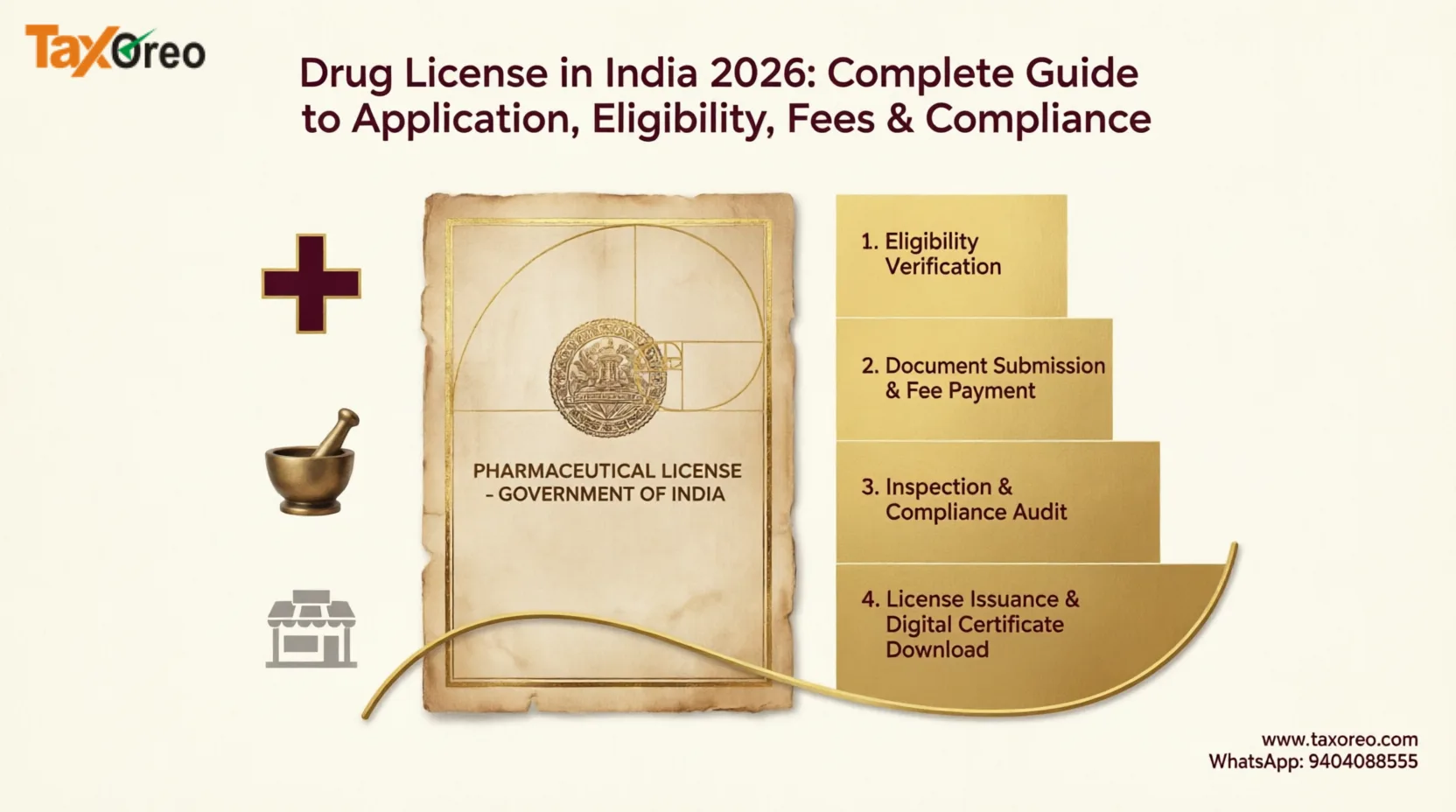
Drug License in India 2026: Complete Guide to Application, Eligibility, Fees & Compliance
Disclaimer: This blog is original, research-based content compiled from official government sources including the Drugs and Cosmetics Act, 1940, CDSCO guidelines, and State Drug Control Department notifications. The information is accurate as of March 2026. However, pharmaceutical regulations are subject to change. Readers are strongly advised to consult qualified regulatory professionals or legal experts before making business decisions. This content is for informational purposes only and does not constitute legal advice.
Regulatory Notice: Drug licensing rules, fee structures, and procedural requirements may be updated by State Drug Controllers or CDSCO. Always verify current requirements on your state's official Drug Control portal or the CDSCO SUGAM portal (cdscoonline.gov.in) before initiating applications.
Executive Summary: Every Business Owner Must Know
- Mandatory Requirement: Any entity manufacturing, selling, stocking, or distributing drugs in India must obtain a valid drug license under the Drugs and Cosmetics Act, 1940. Operating without one attracts criminal penalties including imprisonment up to 3 years and fines up to ₹1 lakh under Section 27.
- License Types: Retail (Form 20/21), Wholesale (Form 20B/21B), Manufacturing (CDSCO-issued), and specialized licenses for Schedule C/C1 drugs, Schedule X substances, or AYUSH products.
- Validity Update (Critical): Under amended Rule 63 (G.S.R. 1337(E)), drug licenses are now perpetual no longer expire every 5 years. However, a retention fee equal to the original grant fee must be paid every 5 years to keep the license active.
- Application Process: Applications are filed online via State Drug Control portals for retail/wholesale licenses or the CDSCO SUGAM portal for manufacturing/import licenses. Processing typically takes 15-45 days depending on state and inspection timelines.
- Key Prerequisites: Minimum premises area (10 sq. m for retail, 15 sq. m for wholesale), appointment of a registered pharmacist (retail) or competent person (wholesale), and compliance with storage/hygiene standards.
- 2026 Focus Areas: Enhanced digital compliance via SUGAM portal, stricter documentation verification, and risk-based inspection schedules (minimum once every 3 years).
- Professional Support Recommended: Given the technical nature of applications and inspection preparedness, engaging regulatory consultants like Taxoreo (www.taxoreo.com) can significantly reduce approval timelines and compliance risks.
Definition: What Exactly Is a Drug License?
Official/Legal Definition
Under Section 3(b) of the Drugs and Cosmetics Act, 1940, a "drug" includes all medicines for internal or external use, diagnostic substances, vaccines, sera, medical devices (as notified), and cosmetics. Section 18 prohibits the manufacture, sale, or distribution of any drug without a license issued by the appropriate licensing authority. Licenses are granted under Rules 64-85 of the Drugs and Cosmetics Rules, 1945, with specific forms prescribed for different activities:
- Form 20/21: Retail sale of allopathic drugs (general/Schedule C/C1)
- Form 20B/21B: Wholesale distribution
- Form 25/28: Manufacturing (issued by CDSCO)
- Form 43: Import registration certificate
Plain English Explanation
Think of a drug license as a "government-issued permission slip" that certifies your business meets the safety, quality, and professional standards required to handle medicines. Just as a driver's license proves you're qualified to operate a vehicle, a drug license proves your pharmacy, warehouse, or manufacturing unit is legally authorized to deal in pharmaceutical products. Without it, selling even a single strip of paracetamol is illegal.
Practical Purpose & Real-World Application
- For Retail Pharmacies: Enables you to legally dispense prescription and OTC medicines to patients. Required for empanelment with insurance providers and hospital networks.
- For Wholesalers: Allows bulk supply to pharmacies, hospitals, and clinics. Mandatory for participation in government tenders.
- For Manufacturers: Essential for production, packaging, and labelling of drugs. Required for product registration with CDSCO.
- For E-Pharmacies: Digital platforms must hold a valid state-level drug license to operate legally under the 2023 e-pharmacy draft rules framework.
Eligibility & Qualification Criteria
Who Can Apply/Qualify
- Retail Drug License (Form 20/21):
- Individuals, proprietorships, partnerships, LLPs, or companies
- Must employ a registered pharmacist (B. Pharm/ D. Pharm with State Pharmacy Council registration) present during all business hours
- Premises minimum 10 square meters with proper ventilation, lighting, and storage facilities
- Clean criminal record (affidavit of non-conviction under D&C Act required)
- Wholesale Drug License (Form 20B/21B):
- Same business structures as retail
- Must appoint a competent person: Pharmacy graduate with 1 year experience OR pharmacy undergraduate with 4 years’ experience in drug handling
- Premises minimum 15 square meters with adequate storage, pest control, and temperature management
- Cold storage facility mandatory if dealing with Schedule C/C1 drugs (vaccines, insulin, biologics)
- Manufacturing License (CDSCO):
- Registered companies/LLPs with manufacturing infrastructure
- Compliance with Schedule M (Good Manufacturing Practices)
- Approved technical staff (qualified chemists, microbiologists, QA personnel)
- Valid factory license and pollution control clearances
Who Cannot Apply/Qualify
- Individuals below 18 years of age
- Persons convicted under the Drugs and Cosmetics Act or NDPS Act
- Premises located in residential zones without commercial conversion approval (varies by municipal rules)
- Businesses with suspended/cancelled licenses in the past 3 years (subject to state discretion)
- Applications with mismatched documents (e.g., pharmacist registration not matching business address)
Critical Registration Notes
- Pharmacist Registration Must Be Active: The pharmacist's State Pharmacy Council registration must be valid and linked to your business address. Lapsed registrations cause immediate rejection.
- Premises Proof is Non-Negotiable: Rent agreements must be registered; ownership documents must match the applicant's name. Electricity bills in the business name serve as secondary proof.
- State-Specific Variations: While the D&C Act is central, procedural rules, fee structures, and portal interfaces differ by state. Always check your State Drug Control Department website first.
Validity & Renewal: Critical Timeline Management
|
Time Period |
Validity Status |
Required Action |
|
Day of Grant |
License issued in Form 20/21/20B/21B |
Display prominently at business premises; maintain digital copy |
|
Years 1-4 |
Active and valid |
Maintain compliance records; prepare for periodic inspection |
|
Before 5th Anniversary |
Retention Fee Due |
Pay retention fee (equal to original grant fee) via state portal to keep license active |
|
Every 3 Years |
Inspection Cycle |
Cooperate with Drug Inspector's risk-based or scheduled inspection |
|
After 5 Years (Fee Unpaid) |
License Deemed Inactive |
Cannot legally deal in drugs; reinstatement requires fresh application + penalties |
Critical Warning: Failure to pay the 5-year retention fee results in your license being deemed inactive. Continuing operations attracts penalties under Section 27. Reinstatement is not automatic it requires a fresh application, re-inspection, and payment of late fees. Many businesses mistakenly believe "perpetual" means "no further action required."
Key Compliance Risks with Specific Impacts
- Missed Retention Fee Deadline (Every 5 Years): License becomes inactive; business operations must halt immediately. Financial impact: Loss of revenue + potential penalty of ₹5,000-₹25,000 for late payment (state-dependent).
- Failed Inspection (Every 3 Years): Non-compliance with storage, documentation, or personnel requirements can lead to suspension. Impact: 15–30-day business disruption during rectification.
- Pharmacist Attrition (Retail): If your registered pharmacist resigns and isn't replaced within 15 days, the license becomes non-compliant. Impact: Show-cause notice + potential suspension.
- Schedule C/C1 Cold Chain Failure: Temperature excursions during storage can trigger license review. Impact: Product seizure + compliance audit.
Step-by-Step Process Guide: From Application to Approval
Prerequisites Checklist
- Business registration (Proprietorship/Partnership/Company/LLP)
- Premises with minimum area (10/15 sq. m) and commercial use approval
- Registered pharmacist (retail) or competent person (wholesale) with valid credentials
- Identity proofs (PAN, Aadhaar) of applicant and key personnel
- Premises proof: Registered rent agreement/sale deed + electricity bill
- Site plan/layout showing storage, dispensing, and cold chain areas
- Affidavit of non-conviction under D&C Act (notarized)
Detailed Application Steps (State Portal Example)
Step 1: Access Your State Drug Control Portal
- Navigate to your state's official portal (e.g., drugs.delhi.gov.in, mahascd.gov.in)
- Alternative: For manufacturing/import, use CDSCO SUGAM portal: sugam.cdsco.gov.in
Step 2: Register/Login to User Dashboard
- Click "New User Registration" → Enter business email, mobile, and PAN
- Verify via OTP → Set password → Login to dashboard
Step 3: Select License Type & Initiate Application
- Dashboard → "New Application" → "Drug License" → Select:
- Retail: Form 20 (general) + Form 21 (Schedule C/C1 if applicable)
- Wholesale: Form 20B + Form 21B
- Note: Schedule X (narcotics) requires additional Form 20F/20G
Step 4: Fill Form 19 (Application for Grant of License)
- Business Details Tab: Enter legal name, constitution, GSTIN, address
- Premises Tab: Upload site plan, area proof, photos of storage facilities
- Personnel Tab: Upload pharmacist/competent person certificates, appointment letter, registration proof
- Declaration Tab: Digitally sign affidavit of compliance
Step 5: Upload Supporting Documents
- Mandatory uploads (PDF/JPG, <2MB each):
- Identity proof of applicant
- Business constitution document
- Premises ownership/rental proof
- Pharmacist registration certificate
- Site plan with dimensions
- Cold storage proof (if applicable)
Step 6: Pay Application Fee
- Fee calculated automatically based on license type and state
- Payment via Bharatkosh/online banking (receipt generated instantly)
- Typical Fees: Retail ₹1,500-3,000; Wholesale ₹3,000-6,000 (varies by state)
Step 7: Submit & Track Application
- Review all entries → Submit → Note acknowledgment number
- Track status under "My Applications" tab
- Respond to queries within 15 days to avoid rejection
Step 8: Drug Inspector Inspection
- Inspector schedules visit via portal/SMS (typically 7-30 days post-submission)
- Prepare: Original documents, premises cleanliness, pharmacist presence, cold chain logs
- Inspection report uploaded to portal within 48 hours
Step 9: License Grant
- Upon satisfactory inspection, Drug Controller approves application
- License (Form 20/21/20B/21B) available for download in dashboard
- Print, sign, and display at business premises
Post-Submission Status Tracking
|
Status Name |
Meaning & Implications |
Typical Timeframe |
|
Submitted |
Application received; under preliminary scrutiny |
1-3 days |
|
Query Raised |
Additional documents/information required |
Respond within 15 days |
|
Inspection Scheduled |
Drug Inspector visit assigned |
7-30 days after query closure |
|
Inspection Completed |
Report submitted; pending approval |
3-7 days post-inspection |
|
Approved |
License granted; available for download |
Immediate upon approval |
|
Rejected |
Application deficient; reasons provided in portal |
Can reapply after rectification |
|
Deemed Approved |
If no decision within 60 days (state-dependent), application may be deemed approved under some state rules |
60+ days |
Documentation Requirements: Myth vs Reality
|
Document |
Required Upload? |
Purpose |
|
PAN Card of Applicant |
Yes |
Identity verification and fee processing |
|
Aadhaar Card |
Yes |
Address proof and biometric linkage |
|
Business Registration Certificate |
Yes |
Legal entity validation (Partnership Deed/MOA) |
|
Rent Agreement (Registered) |
Yes |
Premises legitimacy and commercial use proof |
|
Electricity Bill (Business Name) |
Yes |
Secondary address verification |
|
Pharmacist Registration Certificate |
Yes |
Mandatory personnel qualification proof |
|
Pharmacist Appointment Letter |
Yes |
Employment relationship documentation |
|
Site Plan/Layout Drawing |
Yes |
Premises compliance verification (area, storage) |
|
Cold Storage Purchase Invoice |
Yes (if Schedule C/C1) |
Temperature-controlled storage capability |
|
Affidavit of non-conviction |
Yes |
Legal eligibility confirmation |
|
GST Registration Certificate |
No |
Not mandatory for license grant (but required for operations) |
|
Trade License from Municipality |
No |
Separate requirement; not part of drug license application |
|
Bank Statement |
No |
Not required unless specifically queried |
|
Photographs of Premises |
Sometimes |
Some states request; keep 4-6 ready |
Key Insight: The drug license application process operates on a self-declaration with verification model. While you upload documents digitally, the Drug Inspector physically verifies premises and original documents during inspection. Maintain a "compliance file" with all originals and updated records (pharmacist attendance, temperature logs, purchase bills) for audit readiness. Digital uploads are just the first step physical verification is decisive.
For seamless document compilation and portal navigation, Taxoreo's regulatory team (www.taxoreo.com) provides end-to-end application support with 95% first-time approval rates.
Legal Conditions & Compliance Timelines
Mandatory Compliance Requirements
|
Requirement |
Specific Timeline |
Consequence of Default |
Penalty/Interest (Legal Reference) |
|
Retention Fee Payment |
Every 5 years from license grant date |
License deemed inactive; operations must cease |
Late fee: 10-25% of original fee (State Rules); Reapplication costs |
|
Drug Inspector Inspection |
Minimum once every 3 years (Rule 63) |
Suspension if non-compliant; show-cause notice |
Section 27: Up to 3 years imprisonment + ₹1 lakh fine |
|
Pharmacist Presence (Retail) |
During all business hours |
License suspension; penalty for unlicensed sale |
Section 27: Same as above; daily penalty until compliance |
|
Schedule C/C1 Temperature Logs |
Continuous monitoring; logs retained 3 years |
Product seizure; license review for cold chain failure |
Rule 97: Confiscation of non-compliant stock |
|
Stock Register Maintenance |
Daily entries; preserved 3 years |
Penalty during inspection; difficulty in recall scenarios |
Rule 65: Fine up to ₹5,000 for record-keeping defaults |
|
Change in Business Constitution |
Notify within 30 days of change |
License invalid if not updated; fresh application needed |
Rule 73: License cancellation for unreported changes |
Key Notes for Compliance Management
- Payment Windows: Retention fee payments open 90 days before the 5-year anniversary. Set calendar reminders to avoid last-minute rushes.
- Documentation Requirements: Maintain digital + physical copies of all compliance records. Inspectors increasingly request digital access during visits.
- Extension Possibilities: No extensions for retention fees. However, inspection timelines may be rescheduled once with valid justification (medical emergency, natural calamity).
- Professional Support: For accurate compliance tracking and deadline management, Taxoreo (www.taxoreo.com) offers automated compliance calendars and reminder services tailored to pharmaceutical businesses.
Comparative Analysis: Retail vs Wholesale vs Manufacturing Licenses
|
Parameter |
Retail License (Form 20/21) |
Wholesale License (Form 20B/21B) |
Manufacturing License (CDSCO) |
|
Initial Government Fee |
₹1,500-3,000 |
₹3,000-6,000 |
₹5,000-25,000+ |
|
Processing Time |
15-30 days |
20-45 days |
90-180 days |
|
Cash Flow Impact |
Low (minimal setup cost) |
Medium (inventory investment) |
High (infrastructure + compliance) |
|
Administrative Burden |
Moderate (pharmacist management) |
Moderate (supply chain documentation) |
High (GMP, QA, regulatory reporting) |
|
Personnel Requirement |
Registered pharmacist (full-time) |
Competent person (can be part-time) |
Technical team + QA/QC staff |
|
Premises Investment |
₹50,000-2,00,000 (10 sq.m setup) |
₹1,00,000-5,00,000 (15 sq.m + storage) |
₹10,00,000+ (Schedule M compliance) |
|
Inspection Frequency |
Risk-based (min. once/3 years) |
Risk-based (min. once/3 years) |
Annual + surprise audits |
|
Scalability |
Limited to single location |
Multi-distribution possible |
National/international supply |
Real-World Impact Analysis: Financial Implications
Scenario 1: Retail Pharmacy Startup (Delhi)
- License fee: ₹2,500
- Premises setup (10 sq.m): ₹1,20,000
- Pharmacist salary (annual): ₹3,00,000
- Total Year 1 Compliance Cost: ~₹4,22,500
- Working Capital Implication: Low entry barrier; break-even typically in 8-12 months with moderate footfall.
Scenario 2: Wholesale Distributor Expansion (Maharashtra)
- License fee: ₹5,000
- Warehouse setup (15 sq.m + cold storage): ₹4,50,000
- Competent person + staff: ₹4,80,000 annually
- Total Year 1 Compliance Cost: ~₹9,35,000
- Working Capital Implication: Higher inventory investment (₹10-25 lakh typical); margin of 8-12% on drug sales.
Scenario 3: Non-Compliance Cost Example
- Operating without license: Section 27 penalty = ₹1,00,000 fine + 3 years imprisonment risk
- Missed retention fee: License inactive → business halt → revenue loss ₹50,000/month + reinstatement cost ₹15,000
- Calculation: ₹50,000 × 3 months downtime = ₹1,50,000 opportunity cost + ₹15,000 reinstatement = ₹1,65,000 avoidable loss
Pro Tip: The 5-year retention fee (equal to original grant fee) is a predictable compliance cost. Budget ₹3,000-6,000 every 5 years per license negligible compared to business disruption costs.
Common Mistakes & Prevention Strategies
|
Common Mistake |
Consequence |
Prevention Strategy |
|
Applying with Incomplete Documents |
Application rejected; 15-30 day delay in re-submission |
Use Taxoreo's document checklist (www.taxoreo.com) to pre-verify all uploads before submission |
|
Premises Area Below Minimum |
Inspection failure; license denial |
Measure premises before application; include storage/dispensing areas in 10/15 sq.m calculation |
|
Pharmacist Registration Mismatch |
Immediate rejection during scrutiny |
Verify pharmacist's State Pharmacy Council registration is active and address-matched before application |
|
Ignoring Schedule C/C1 Requirements |
Cold chain non-compliance; product seizure |
If handling vaccines/insulin, install temperature-monitored refrigerator and maintain digital logs from Day 1 |
|
Missing Retention Fee Deadline |
License deemed inactive; business halt |
Set automated reminders 90 days before 5-year anniversary; use compliance management tools |
|
Not Updating Business Changes |
License invalidation for unreported constitution/address changes |
Notify Drug Controller within 30 days of any change; file modification application via portal |
Real-World Scenario: A Mumbai pharmacy applied with a rent agreement not registered with the sub-registrar. The Drug Inspector rejected the application during document scrutiny, causing a 45-day delay. Prevention: Always use registered rent agreements and keep a copy of the registration receipt.
Frequently Asked Questions (FAQs)
Q1: Can I operate an online pharmacy with just a retail drug license?
A: Yes, but with conditions. Your e-pharmacy must hold a valid state-level retail drug license for the location from which you dispense medicines. Additionally, you must comply with the 2023 Draft E-Pharmacy Rules (when notified), which require prescription verification, data privacy measures, and display of license details on your platform.
Q2: What if my pharmacist resigns suddenly? Does my license become invalid immediately?
A: No, but you have a 15-day grace period to appoint a replacement registered pharmacist. Notify the Drug Controller in writing within 7 days of resignation. Operating beyond 15 days without a pharmacist attracts penalties under Section 27. Maintain a backup pharmacist agreement to mitigate this risk.
Q3: Are there fee concessions for small businesses or startups?
A: Most states do not offer fee concessions for drug licenses. However, some states (e.g., Gujarat, Tamil Nadu) have simplified procedures for micro-enterprises. Check your state's Drug Control website for any startup facilitation policies. Professional service providers like Taxoreo can help identify state-specific benefits.
Q4: Can I transfer my drug license if I sell my business?
A: No, drug licenses are non-transferable. The new owner must apply for a fresh license in their name. However, the application process is expedited if premises and infrastructure remain unchanged. File the new application before business transfer to avoid operational gaps.
Q5: What happens if my license application is rejected?
A: You receive a rejection order with specific reasons via the portal. Common reasons: document mismatch, premises non-compliance, or pharmacist eligibility issues. You can: (a) Rectify deficiencies and reapply, or (b) File an appeal with the State Drug Controller within 30 days. Professional representation increases appeal success rates.
Q6: Do I need separate licenses for allopathic and AYUSH medicines?
A: Yes. Allopathic drugs require licenses under the Drugs and Cosmetics Act (State Drug Controller). AYUSH products (Ayurvedic, Unani, Siddha, Homeopathic) require separate licenses from the State AYUSH Department under the respective Acts. One premises can hold multiple licenses if areas are demarcated.
Q7: How are Schedule X drugs (narcotics) regulated differently?
A: Schedule X substances (e.g., certain painkillers, psychotropics) require additional licenses: Form 20F (retail) or Form 20G (wholesale). These involve stricter record-keeping (separate registers), secure storage (locked cabinets), and mandatory reporting of sales to state authorities. Applications undergo enhanced scrutiny.
Q8: Can foreign companies obtain drug licenses in India?
A: Yes, but through a local entity. Foreign manufacturers must appoint an Indian Authorized Agent and obtain an Import Registration Certificate (Form 43) from CDSCO. For retail/wholesale operations, they must incorporate an Indian company/LLP first. The SUGAM portal facilitates foreign applicant registration.
Latest Updates & Changes for FY 2025-26
- SUGAM Portal 2.0 Enhancements (CDSCO): Launched January 2026 with AI-based document verification, reducing query cycles by 40%. Now supports bulk applications for multi-location businesses.
- Risk-Based Inspection Framework: Implemented across 18 states from April 2025. Low-risk compliant businesses now face inspections once in 5 years instead of 3, reducing compliance burden.
- Digital License Display Mandate: From October 2025, all licensed entities must display a QR-coded digital license on their premises (in addition to physical copy). Scannable by inspectors for real-time verification.
- Cold Chain Monitoring Integration: Schedule C/C1 license holders must now integrate temperature loggers with state drug control portals for real-time monitoring (pilot in Maharashtra, Karnataka).
- Retention Fee Payment Simplification: Bharatkosh integration now allows auto-debit setup for 5-year retention fees, preventing accidental lapses. Available on 22 state portals as of March 2026.
Action Checklist: Your Drug License Compliance Calendar
By 31 March 2026 (End of FY)
- Verify all active drug licenses' next retention fee due dates (5-year anniversary)
- Update pharmacist/competent person records with current registration certificates
- Conduct internal audit of stock registers and temperature logs for inspection readiness
- Renew any expiring premises documents (rent agreements, electricity proofs)
- Backup all compliance documents digitally with cloud storage
Quarterly/Periodic Tasks
- Review and update Standard Operating Procedures (SOPs) for drug handling
- Train staff on latest regulatory updates (subscribe to CDSCO/state alerts)
- Reconcile purchase/sales records with GST returns for consistency
- Test cold chain equipment and calibrate temperature monitoring devices
By 31 March 2027 (Next FY Planning)
- Budget for upcoming retention fee payments (schedule auto-debit if available)
- Plan premises upgrades if expanding product categories (e.g., adding Schedule C/C1)
- Evaluate compliance management software for automated deadline tracking
For strategic license planning, application support, or compliance management, Taxoreo's specialized pharmaceutical regulatory services (www.taxoreo.com) offer end-to-end solutions tailored to Indian drug laws. Our team of ex-regulatory professionals ensures your applications are inspection-ready and your compliance calendar is automated.
Contact Taxoreo Today:
🌐 www.taxoreo.com
📱 WhatsApp: +91 94040 88555
Need Expert Assistance? Navigating drug license applications, inspections, or compliance management can be complex. Taxoreo specializes in pharmaceutical regulatory services across India. From document preparation to inspector liaison, we ensure your license journey is smooth and compliant.
Visit: www.taxoreo.com
WhatsApp: +91 94040 88555