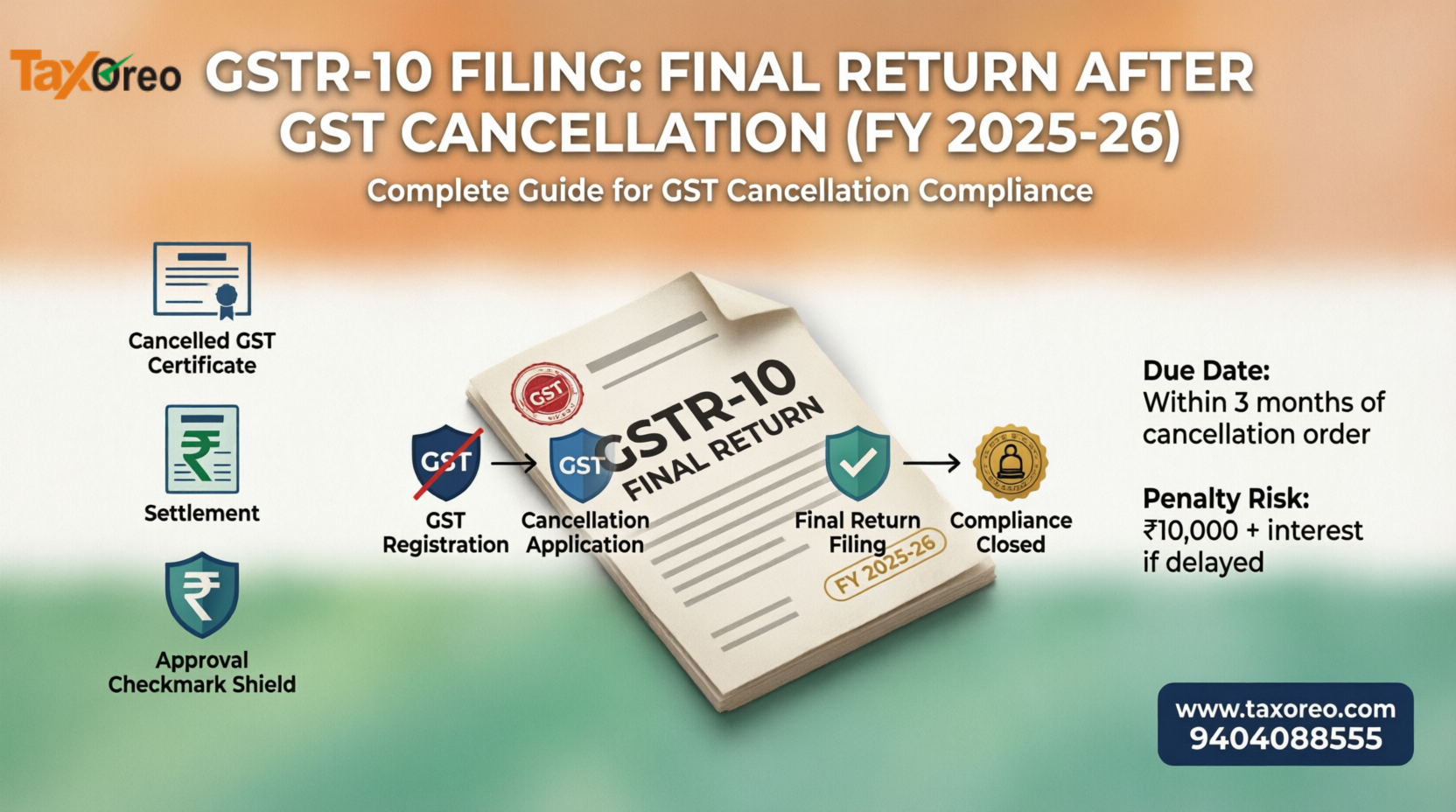
GSTR-10 Filing: The Complete Authoritative Guide to Final Return Submission After GST Cancellation (FY 2025-26)
Disclaimer: This comprehensive guide is original, research-based content compiled from official Government of India sources including the GST Portal, CGST Act, Rules, and CBIC notifications. While every effort has been made to ensure accuracy, GST regulations are subject to change. Readers are strongly advised to consult a qualified Chartered Accountant or GST practitioner before making compliance decisions. Information presented is accurate as of March 2026 for Financial Year 2025-26.
📊 Executive Summary: What Every Taxpayer Must Know About GSTR-10
- Mandatory Filing: GSTR-10 is the final return that must be filed by every registered person whose GST registration has been cancelled or surrendered under Section 45 of the CGST Act.
- Critical Deadline: File within 3 months from the date of cancellation OR the date of the cancellation order, whichever is later. Missing this deadline attracts escalating late fees and potential prosecution.
- Core Purpose: The return captures details of closing stock, ITC reversal, and tax payable on goods held at the time of business cessation to ensure no unaccounted tax liability remains.
- Eligibility Exclusions: Input Service Distributors (ISD), Composition taxpayers, Non-Resident Taxable Persons, TDS deductors (Section 51), and TCS collectors (Section 52) are not required to file GSTR-10.
- Prerequisite Compliance: All pending GSTR-1, GSTR-3B, and CMP-08 returns for the relevant financial year must be filed first; otherwise, the GSTR-10 option remains disabled on the portal.
- No Revision Allowed: Once filed, GSTR-10 cannot be revised or edited. Accuracy in stock valuation and ITC reversal calculations is critical before submission.
- Professional Certification: For closing stock declared without invoices, a certificate from a practicing Chartered Accountant or Cost Accountant is mandatory as per CGST Rule 44(3).
Definition Section: Understanding GSTR-10 in Legal and Practical Terms
Official/Legal Definition
"Every registered person who is required to furnish a return under sub-section (1) of section 39 and whose registration has been cancelled shall furnish a final return within three months of the date of cancellation or date of order of cancellation, whichever is later, in such form and manner as may be prescribed."
— Section 45 of the Central Goods and Services Tax Act, 2017, read with Rule 81 of the CGST Rules, 2017
Plain English Explanation
Think of GSTR-10 as the "exit interview" for your GST registration. Just as an employee submits a final settlement when leaving a company, a business must submit GSTR-10 to:
- Declare all goods (raw materials, finished products, capital assets) still in stock when operations ceased
- Reverse any Input Tax Credit (ITC) claimed on those goods that won't be used for taxable supplies
- Pay any outstanding tax liability before the GST registration is formally closed
Practical Purpose & Real-World Application
GSTR-10 prevents tax leakage by ensuring that ITC availed on inputs is reversed if those inputs are not ultimately used for taxable outward supplies. For example: If you claimed ₹5 lakh ITC on raw materials but still have ₹20 lakh worth of unsold stock when cancelling registration, you must reverse the proportionate ITC and pay applicable tax on that closing stock.
✅ Eligibility & Criteria: Who Must (and Must Not) File GSTR-10
Who Can/Qualify to File GSTR-10
- Voluntary Surrender: Taxpayers who applied for cancellation using Form REG-16 and received approval.
- Departmental Cancellation: Registrations cancelled by tax authorities due to non-compliance, fraud, or inactivity.
- Business Closure: Proprietorships, Partnerships, Companies, or LLPs ceasing operations permanently.
- Change in Constitution: Entities converting from one business structure to another requiring fresh registration.
- Transfer/Merger: Businesses where assets/liabilities are transferred, necessitating cancellation of the transferor's GSTIN.
Who Cannot/Qualify (Exclusions)
- ❌ Input Service Distributors (ISD) – File separate returns under Rule 39
- ❌ Composition Scheme Taxpayers – File final return in Form GST CMP-08 instead
- ❌ Non-Resident Taxable Persons (NRTP) – Subject to separate cancellation procedures
- ❌ Persons deducting TDS under Section 51 – File returns in Form GSTR-7
- ❌ Persons collecting TCS under Section 52 – File returns in Form GSTR-8
- ❌ Casual Taxable Persons – Registration expires automatically; no GSTR-10 required
Critical Registration Notes
- Mandatory Pre-Filing: Ensure all pending GSTR-1 (outward supplies) and GSTR-3B (summary returns) are filed for all periods up to the cancellation date. The GST portal will block GSTR-10 access otherwise.
- ARN Dependency: You can only prepare GSTR-10 after receiving the Application Reference Number (ARN) for your cancellation request or the formal cancellation order.
- Single Filing per GSTIN: Each cancelled GST registration requires exactly one GSTR-10 filing – no multiple submissions allowed.
⏱️ Validity & Renewal Section: Deadlines, Consequences & Compliance Risks
|
Time Period Reference |
Validity Window |
Required Action |
|
Date of Cancellation (e.g., 15-Jan-2026) |
15-Jan-2026 to 14-Apr-2026 |
File GSTR-10 on or before 14-Apr-2026 |
|
Date of Cancellation Order (e.g., 25-Jan-2026) |
25-Jan-2026 to 24-Apr-2026 |
File GSTR-10 on or before 24-Apr-2026 |
|
Whichever is LATER |
3 calendar months from later date |
Submit with tax payment & verification |
Critical Warning: Failure to file GSTR-10 within the stipulated 3-month window triggers:
- Late fee of ₹200 per day (₹100 CGST + ₹100 SGST) with no statutory upper limit in many interpretations.
- Issuance of notice under Section 46 demanding return filing within 15 days.
- Final assessment order under Section 62 determining tax liability + interest + penalty.
- Potential prosecution under Section 122 for wilful suppression of stock details.
Key Compliance Risks with Specific Impacts
- ITC Reversal Miscalculation (By Due Date): Under-reversing ITC on closing stock attracts demand + 18% p.a. interest under Section 50. Example: ₹10 lakh un-reversed ITC = ₹1.5 lakh interest for 1-year delay.
- Stock Valuation Errors (At Filing): Declaring stock at purchase value instead of market value (Rule 44(3)) may lead to departmental reassessment and penalty up to 100% of tax evaded.
- Missing CA Certificate (If invoices unavailable): For stock without invoices, omission of CA/cost accountant certification invalidates the declaration, risking rejection and notice.
- Non-Payment of Calculated Tax (At Filing): Filing without offsetting liability via cash/credit ledger results in "Filed but Defective" status, requiring re-filing + additional late fees.
Step-by-Step Process Guide: Filing GSTR-10 on the GST Portal
Prerequisites Checklist
- ✅ Active GST portal credentials (Username/Password + DSC/EVC enabled)
- ✅ Cancellation ARN or formal cancellation order copy
- ✅ All pending GSTR-1, GSTR-3B, CMP-08 returns filed for relevant FY
- ✅ Closing stock register with invoice-wise details (or CA certificate if invoices missing)
- ✅ Capital goods register with purchase dates for ITC reversal calculation (1/60th per month rule)
- ✅ Electronic Cash/Credit Ledger balance sufficient for tax payment
Detailed Filing Steps (Online Method)
Step 1: Portal Navigation
- Visit www.gst.gov.in → Login with credentials
- Navigate: Services → Returns → Final Return
- Select Financial Year and click SEARCH
- In the GSTR-10 tile, click PREPARE ONLINE
Step 2: Update Correspondence Address
- Enter address for future communications (auto-populated if REG-16 was used; editable otherwise)
- Click SAVE → Confirm success message
Step 3: CA/Cost Accountant Details (If Applicable)
- If declaring stock without invoices, enter:
- Firm name, CA/CMA name, Membership number, Certificate date
- Upload scanned CA certificate (PDF, max 5MB)
- Click SAVE CA details
Step 4: Enter Closing Stock Details
Tile 8A, 8B & 8C – Goods with Invoices
- Click ADD DETAILS → Select supplier registration type (GST/CX/VAT)
- For GST suppliers: Enter GSTIN, Invoice No., Date, Item details (HSN, Qty, Value, Tax)
- Click ADD → SAVE for each invoice line
- Repeat for all invoice-supported stock
Tile 8D – Goods Without Invoices
- Use this tile only when original purchase invoices are unavailable
- Enter goods description, UQC, quantity, taxable value, tax components
- Mandatory: Attach CA certificate justifying market value estimation per Rule 44(3)
Step 5: Preview & Validate
- Click PREVIEW DRAFT GSTR-10 to download summary PDF
- Verify: Stock values, ITC reversal amounts, tax payable calculations
- Cross-check with physical stock register and CA certificate (if applicable)
Step 6: Payment of Tax Liability
- Click PROCEED TO FILE → System validates entries
- Navigate to Tile 9 & 10: Amount of tax payable and paid
- System displays:
- Tax payable (CGST/SGST/IGST/Cess)
- Available Cash/Credit Ledger balance
- Auto-calculated late fee (if applicable)
- Scenario A: Sufficient ledger balance → System auto-offsets liability
- Scenario B: Insufficient balance → Click CREATE CHALLAN → Pay via Net Banking/NEFT/RTC
- Click PREVIEW DRAFT GSTR-10 again post-payment to confirm zero outstanding liability
Step 7: Final Submission
- Check declaration box: "I solemnly declare that the information is true..."
- Select Authorized Signatory from dropdown
- Click FILE GSTR-10 → Confirm with YES
- Authenticate via:
- DSC: Select certificate → SIGN
- EVC: Enter OTP sent to registered mobile/email → VALIDATE
- Note the ARN (Application Reference Number) displayed on success screen
Step 8: Post-Filing Actions
- Click DOWNLOAD FILED GSTR-10 to save final PDF (watermarked "FILED")
- Verify SMS/email confirmation on registered contacts
- Update internal records: Mark GSTIN as "Closed – GSTR-10 Filed [Date]"
Post-Submission Status Reference Table
|
Status Name |
Meaning & Implications |
Typical Timeframe |
|
Ready to File |
All entries validated; payment tile enabled |
Immediate after preview |
|
Filed |
Return successfully submitted; ARN generated |
Instant upon DSC/EVC validation |
|
Pending for Payment |
Entries saved but tax liability not offset |
Until challan payment confirmed |
|
Rejected |
Technical/validation errors (e.g., invalid GSTIN format) |
24-48 hours; re-filing required |
|
Deemed Approved |
No departmental query within 30 days of filing |
30 days post-filing (implicit) |
Note: Unlike regular returns, GSTR-10 does not undergo automated processing. "Filed" status generally indicates acceptance unless a notice is issued under Section 73/74.
📋 Documentation Requirements: Myth vs Reality
|
Document |
Required Upload? |
Purpose & Usage |
|
Closing Stock Register (Invoice-wise) |
❌ No (but retain physically) |
Basis for Tables 8A-8C entries; must produce if queried |
|
CA/Cost Accountant Certificate |
✅ Yes (if invoices missing) |
Validates market value estimation for stock under Rule 44(3) |
|
Cancellation Order Copy |
❌ No (system auto-fetches) |
Reference for effective date; keep for records |
|
Capital Goods Purchase Invoices |
❌ No (but retain) |
Supports ITC reversal calculation (1/60th per month rule) |
|
GSTR-1 & GSTR-3B Acknowledgments |
❌ No |
Proof of pre-filing compliance; useful for audit trail |
|
Bank Payment Challan |
❌ No (auto-linked) |
Evidence of tax payment; downloadable from portal post-filing |
Key Insight: GSTR-10 operates on a self-declaration with document retention model. While uploads are minimal, you must retain all supporting documents for 6 years (Section 36 of CGST Act). During scrutiny, failure to produce invoices or CA certificates can lead to disallowance of stock declarations and demand creation.
Legal Conditions & Compliance Timelines
Mandatory Requirements Table
|
Requirement |
Specific Timeline |
Consequence of Default |
Penalty/Interest Reference |
|
File GSTR-10 |
3 months from cancellation date/order (whichever later) |
Notice u/s 46 → Final order u/s 62 |
Late fee: ₹200/day (₹100 CGST+₹100 SGST) |
|
Reverse ITC on Closing Stock |
At time of GSTR-10 filing |
Demand + interest on un-reversed credit |
Interest: 18% p.a. u/s 50(1) from due date |
|
Pay Tax on Stock Declaration |
Before final submission |
Return marked "Defective"; re-filing needed |
Late fee continues until payment + interest |
|
File Pending GSTR-1/3B |
Before accessing GSTR-10 |
Portal blocks GSTR-10 preparation |
Separate late fees for each delayed return |
|
Retain Supporting Documents |
6 years from due date of annual return for that FY |
Penalty up to ₹25,000 u/s 125 for non-production |
Section 36 read with Section 125 |
Key Notes for Compliance
- Payment Window: Tax liability must be paid before final submission. The portal does not allow "file now, pay later" for GSTR-10.
- Documentation: Maintain a dedicated "GSTR-10 Compliance Folder" with stock registers, CA certificates, and payment proofs for audit readiness.
- Extensions: No statutory extension exists for GSTR-10. However, CBIC occasionally issues amnesty schemes (e.g., Notification No. 8/2023 capped late fees at ₹1,000 for filings between Apr-Jun 2023). Monitor GST Council announcements for such relief.
- Professional Support: For accurate ITC reversal calculations under Rule 44, Taxoreo's GST closure specialists provide end-to-end support including stock valuation, CA coordination, and portal filing.
Comparative Analysis: Voluntary Surrender vs Departmental Cancellation
|
Parameter |
Voluntary Surrender (REG-16) |
Departmental Cancellation |
|
Initiation |
Taxpayer applies proactively |
Tax officer initiates show-cause notice |
|
Processing Time |
30-60 days for approval |
60-180 days (adjudication timeline) |
|
GSTR-10 Due Date Clarity |
Clear: 3 months from approval date |
Uncertain: 3 months from order date (may follow lengthy proceedings) |
|
ITC Reversal Flexibility |
Full control over stock declaration timing |
May face scrutiny on stock valuation during cancellation proceedings |
|
Late Fee Risk |
Low (if filed within 3 months of approval) |
High (delay in order issuance compresses filing window) |
|
Cash Flow Impact |
Predictable tax payment at filing |
Potential demand with interest if department disputes stock value |
|
Administrative Burden |
Moderate (self-managed filing) |
High (responding to notices + GSTR-10 preparation) |
|
Re-registration Possibility |
Easier: Fresh application post-6 months |
Complex: Must resolve cancellation reasons first |
Real-World Impact Analysis
Scenario: A Pune-based manufacturer with ₹50 lakh closing stock (ITC availed: ₹9 lakh @ 18%) cancels registration on 10-Feb-2026.
- Voluntary Surrender Path:
- Approval received: 15-Mar-2026
- GSTR-10 due date: 14-Jun-2026
- ITC reversal: ₹9 lakh paid via credit ledger on 10-Jun-2026
- Working Capital Impact: ₹9 lakh blocked from Feb-Jun (4 months); opportunity cost ~₹1.8 lakh @ 12% p.a.
- Departmental Cancellation Path:
- Show-cause notice: Jan-2026; Final order: 30-Apr-2026
- GSTR-10 due date: 29-Jul-2026
- Department disputes stock value; reassesses at ₹60 lakh → Additional tax demand: ₹1.8 lakh + 18% interest from Apr-Jul = ₹81,000
- Working Capital Impact: Unplanned outflow of ₹1.89 lakh + compliance costs for responding to notices
Practical Takeaway: Voluntary surrender provides predictability and control over cash flow and compliance timelines. Proactive closure is financially prudent versus reactive departmental action.
Common Mistakes & Prevention Strategies
|
Common Mistake |
Consequence |
Prevention Strategy |
|
Filing before pending GSTR-1/3B |
Portal error: "GSTR-10 not enabled" |
Run "Returns Dashboard" report first; clear all pending returns |
|
Incorrect ITC reversal calculation |
Demand + 18% interest on short reversal |
Use Rule 44 formula: For capital goods, reverse = (ITC availed) × (Remaining useful life in months/60) |
|
Declaring stock without CA certificate |
Rejection or notice for unverified valuation |
Engage CA early if invoices missing; obtain certificate before portal entry |
|
Missing the "later date" deadline |
Late fees accumulating at ₹200/day |
Set calendar reminder for: Cancellation date + 3 months AND Order date + 3 months; file by earlier of the two deadlines |
|
Using purchase value instead of market value |
Departmental reassessment + penalty |
For stock without invoices, estimate market value per Rule 44(3) with CA support; document methodology |
|
Filing with insufficient ledger balance |
"Pending for Payment" status; delayed closure |
Pre-check Cash/Credit Ledger balance; create challan 24 hours before filing to ensure payment reflection |
Real-World Scenario: A Delhi trader declared ₹15 lakh closing stock at purchase value (₹2.7 lakh ITC) without CA certificate. Department issued notice, reassessed stock at market value (₹22 lakh), and demanded additional tax of ₹1.26 lakh + ₹1.89 lakh interest. Prevention: A ₹15,000 CA certification fee would have avoided ₹3.15 lakh in liabilities.
❓ Frequently Asked Questions (FAQs)
Q1: Can I file a NIL GSTR-10 if I have no closing stock?
Yes. If all inputs/capital goods were fully consumed or sold before cancellation, declare "NIL" in Tables 8A-8D. However, you must still complete all other sections (GSTIN, cancellation details, verification) and file the return. A NIL filing still generates an ARN and formally closes your compliance obligations.
Q2: What if my cancellation order is dated 31-Mar-2026? When is the exact due date?
The due date is 30-Jun-2026 (3 calendar months later). Note: The GST portal calculates deadlines by calendar months, not 90 days. Always verify the "Effective Date of Cancellation" displayed in your GSTR-10 dashboard.
Q3: Can I revise GSTR-10 after filing if I discover an error?
No. GSTR-10 is non-revisable once filed with DSC/EVC. If material errors exist (e.g., wrong stock value), you may:
- File a written representation to your jurisdictional officer explaining the error
- Voluntarily pay additional tax + interest via Form GST DRC-03
- Await departmental assessment; cooperate with any scrutiny proceedings
Q4: How is ITC reversal calculated for capital goods under Rule 44?
Formula: Reversal Amount = ITC availed × (Remaining useful life in months ÷ 60)
Example: Machine purchased Jan-2023 for ₹12 lakh (ITC ₹2.16 lakh @18%). Cancelled registration in Mar-2026. Useful life = 5 years (60 months). Elapsed = 39 months. Remaining = 21 months. Reversal = ₹2.16 lakh × (21/60) = ₹75,600 payable via GSTR-10.
Q5: What if I miss the GSTR-10 deadline due to genuine hardship?
While no formal extension exists, you may:
- File belated return immediately (late fees will apply)
- Submit a representation to the adjudicating authority citing reasons (medical emergency, natural calamity)
- Request waiver of late fees under Section 128 (CBIC may issue specific amnesty notifications) Note: Interest on tax liability cannot be waived.
Q6: Does filing GSTR-10 automatically cancel my GSTIN?
No. GSTR-10 is a post-cancellation compliance. Your GSTIN stands cancelled from the "Effective Date" mentioned in the cancellation order. GSTR-10 merely settles final tax liabilities. The status on the portal will show "Cancelled" regardless of GSTR-10 filing status.
Q7: Can a legal heir file GSTR-10 for a deceased proprietor?
Yes. The legal heir must:
- Obtain succession certificate/probate
- Update authorized signatory details on GST portal via Form REG-14
- File GSTR-10 using the deceased's GSTIN within 3 months of cancellation order date Consult a GST practitioner for heir authentication procedures.
Q8: How do I handle stock transferred to a new GSTIN (e.g., business transfer)?
If assets are transferred as a "going concern" under Section 18(3), ITC reversal may not apply. However:
- File GSTR-10 declaring the transfer details
- Attach copy of transfer agreement and new GSTIN details
- The transferee must reverse ITC proportionately if they use assets for exempt supplies Seek professional advice for complex business restructuring scenarios.
Latest Updates & Changes (FY 2025-26)
- Portal Enhancement (Jan-2026): GST portal now auto-populates closing stock values from GSTR-1/3B data where invoice matching exists, reducing manual entry errors for Tables 8A-8C.
- Late Fee Clarification (CBIC Circular 211/5/2024-GST): Confirmed that late fee for GSTR-10 is ₹200/day with no statutory cap, though officers may consider waiver in genuine hardship cases under Section 128.
- Offline Utility Update (v3.2.3, Dec-2025): Enhanced validation rules for HSN-wise stock declaration; added bulk upload feature for Tables 8A-8C via Excel template.
- ITC Reversal Focus Area (FY 2025-26): GSTN analytics now flag disproportionate ITC reversal (<5% of closing stock value) for scrutiny; ensure Rule 44 calculations are well-documented.
- Mobile Accessibility: GST Suvidha Provider (GSP) apps now support GSTR-10 preparation on mobile devices with OTP-based filing, improving accessibility for small taxpayers.
✅ Action Checklist: Your GSTR-10 Compliance Calendar
By [Specific Date: Cancellation Date + 2.5 Months]
- Reconcile physical stock register with purchase invoices
- Calculate ITC reversal for inputs, semi-finished, finished goods (Rule 44(1)(a))
- Compute capital goods reversal using 1/60th per month formula (Rule 44(6))
- Engage CA for certificate if declaring stock without invoices
- Verify pending GSTR-1/3B status; file any outstanding returns immediately
Quarterly/Periodic (During Cancellation Process)
- Monthly: Update stock register for any sales/consumption post-cancellation application
- Pre-filing: Download and validate draft GSTR-10 PDF with CA/finance team
- Payment readiness: Maintain minimum ₹50,000 in Electronic Cash Ledger for unexpected liabilities
- Documentation: Scan and organize all supporting papers in "GSTR-10 Audit Folder"
By [Next Year Date: 31-Mar-2027]
- Retain GSTR-10 filed copy, ARN, and payment challans for 6-year statutory period
- Update business closure records: Note GSTIN cancellation date and GSTR-10 filing reference
- If re-registering later: Ensure 6-month cooling period is complete before fresh application
💡 Expert Recommendation
"Treat GSTR-10 not as a compliance formality, but as a strategic closure exercise. Accurate stock declaration and ITC reversal prevent future demands that can resurrect long after business closure. For complex scenarios—partial stock transfers, capital goods with mixed usage, or valuations without invoices—engage a GST specialist early. The cost of professional guidance (typically ₹10,000-₹25,000) is negligible compared to potential demands of ₹1-5 lakh plus interest. Proactive closure protects your financial legacy."
— GST Compliance Advisory, Taxoreo
For end-to-end GSTR-10 support including stock valuation, CA coordination, and error-free portal filing, Taxoreo's GST closure specialists provide fixed-fee professional services. Visit www.taxoreo.com or WhatsApp 9404088555 for a personalized consultation.
Need Professional Assistance?
Navigating GSTR-10 complexities? Taxoreo offers expert GST closure services including stock valuation, ITC reversal calculations, CA coordination, and portal filing support.
🌐 www.taxoreo.com | 📱 WhatsApp: 9404088555
Trusted by 500+ businesses for compliant, stress-free GST closures.