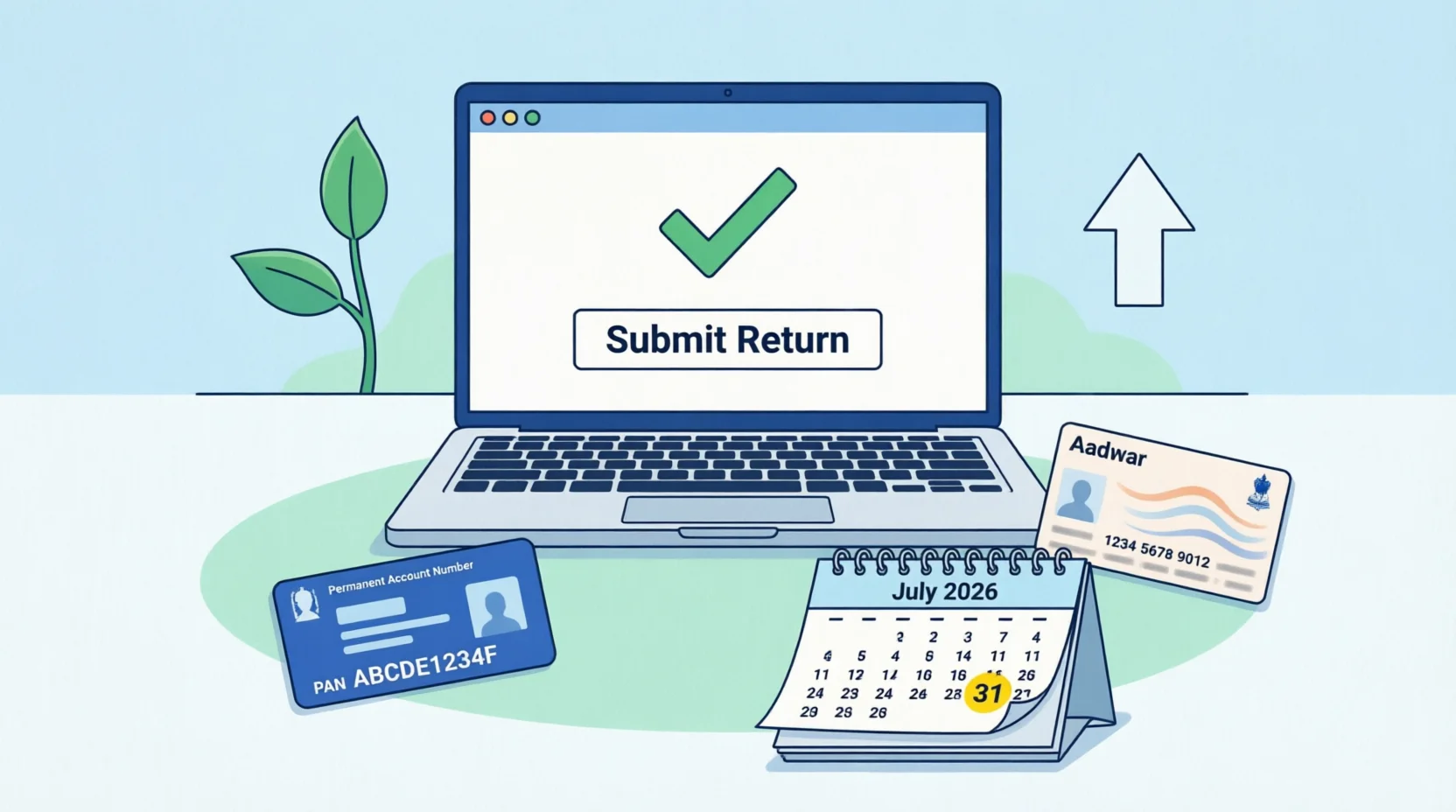
A Simple Guide to Filing Your Income Tax Returns in 2026
Have you ever wondered what the government does with all the money people pay as taxes? Or maybe you are a bit worried because you heard everyone talking about "filing their returns" and you have no idea where to start? Don't worry! This guide is written just for you. We will use very simple words, like we are chatting over a cup of tea. Even if this is the first time you are using a computer, you will be able to understand this.
What is an Income Tax Return (ITR)?
Think of an Income Tax Return Filing as a simple report card. Just like a student shows their grades to their parents at the end of the year, you show your "earnings report" to the government.
You tell them:
- "This is how much money I made this year."
- "This is how much tax I have already paid."
- "This is how much tax I still owe (or if I paid too much and want a refund)."
It is a way to stay honest and help the country grow. The government uses this money to build roads, schools, and hospitals.
Who Manages This System?
The system is managed by the Income Tax Department of India. They have a special website called the e-Filing portal. It is like a big digital office where you can submit your papers without standing in a long line.
Why Use the Website?
The website is designed to make your life easy. Here are some of its best features:
- It Remembers Things: The system already knows your name, your PAN card number, and often even how much salary you got! This is called "pre-filling."
- Wizard Helper: If you don't know which form to pick, the website has a "Wizard" (a helpful guide) that asks you simple questions and picks the right form for you.
- Safe and Secure: Your data is kept very safe, like a digital locker.
- No Paper Needed: You don't need to print anything or go to a physical office. Everything happens on your screen.
Why Must You Do This?
You might think, "Can I just skip this?" The short answer is No. If you earn above a certain amount, filing your return is a legal duty.
What happens if you don't do it?
- Big Fines: If you are late, you have to pay a "late fee." For most people, this is between Rs 1,000/- and Rs 5,000/-.
- Extra Interest: If you owe tax, the government will charge you 1% extra every month you delay. It's like a loan that keeps growing.
- No Refunds: If you paid extra tax (maybe your boss cut too much TDS), the government won't give it back unless you file your return.
- Loan Problems: If you ever want to buy a house or a car, banks will ask for your last three years of tax reports. If you don't have them, you won't get the loan.
- Visa Rejection: Many countries want to see your tax reports before they let you visit.
The clock is ticking! For most people, the last day to file is July 31, 2026. If you miss this, you might lose the chance to save money on taxes.
Which Form Should You Pick?
There are different forms for different people. Think of them like different sized boxes. You just need to pick the box that fits your life.
1. ITR-1 (Also called Sahaj)
This is the simplest form. It is for people who:
- Get a regular ITR-1 Salary or a pension.
- Own only one house.
- Earn less than ₹50 lakh in a year.
- Have simple income like bank interest.
2. ITR-2
This is for people who are a bit more "active" with their money but don't run a business. Pick this if:
- You sold a house or some stocks (this is called "Capital Gains").
- You own more than one house.
- You earn more than ₹50 lakh.
- You are a Director in a company.
3. ITR-3
This is for the "Business Owners" and "Professionals." Pick this if:
- You have a shop, a factory, or a startup.
- You are a doctor, lawyer, or an architect.
- You keep detailed notebooks of all your business spending.
4. ITR-4 (Also called Sugam)
This is for "Small Businesses" who want a shortcut. Instead of counting every single pen or paper you bought for your shop, the government lets you guess your profit as a fixed percentage (like 6% or 8%). This is called the presumptive taxation scheme. It is great for small shopkeepers or freelancers who want to finish their ITR filing quickly.
How to File: A Simple Step-by-Step Guide
Even if you are new to computers, you can follow these steps. Just go slow.
Step 1: Gather Your "Proof"
Before you sit down, have these ready:
- PAN Card and Aadhaar Card.
- Bank Statements: To see how much interest you got.
- Form 16: If you have a job, your boss gives you this. It's a summary of your salary.
Step 2: Log In
Go to the official website: www.incometax.gov.in.
- Click on the "Login" button at the top right.
- Your "User ID" is your PAN number.
- Type in your password. (If it's your first time, you will need to click "Register" first).
Step 3: Start Filing
- On the main screen (the Dashboard), you will see a big button that says "File Now." Click it.
- Select the Assessment Year. For income earned in 2025-2026, you must select 2026-27.
- Select "Online" as the mode of filing.
Step 4: Choose Your Status
The system will ask if you are an "Individual," "HUF," or "Others." If you are filing for yourself, just click Individual.
Step 5: Pick Your Form
The website will ask you questions about your income. Answer them honestly, and it will suggest whether you need ITR-1, ITR-2, ITR-3, or ITR-4.
Step 6: Check the Pre-filled Numbers
This is the "magic" part! You will see that the website already knows many things.
- Check your salary amount.
- Check your bank interest.
- If anything is wrong, you can click on it and change it.
Step 7: Pay Tax (If Any)
If the system says you still owe money, you can pay it right there using your bank's mobile app or a credit card. If the system says you are getting a Refund, make sure your bank account details are correct so the money can come to you!
Step 8: The Final Handshake (Verification)
Your return is not finished until you "verify" it. The easiest way is Aadhaar OTP.
- The system sends a code to your phone.
- You type that code on the screen.
- Boom! You are done.
Helpful Tips for Beginners
- Don't wait for July: Everyone tries to file on the last day, and the website gets very slow. Do it in June or early July to stay stress-free.
- Keep your phone near you: You will need it to receive codes (OTPs) from the bank and the tax department.
- Check your AIS: On the website, there is a section called Annual Information Statement (AIS). It’s like a secret diary the government keeps of your big purchases. Check it to make sure everything matches.
Point to be noted: Filing taxes can sometimes feel like solving a big puzzle. If you have a complicated business or multiple sources of income, it is always better to ask an expert. Errors in filing can lead to notices from the government which can be scary and time-consuming to fix.
For a smooth and worry-free experience, we highly recommend Taxoreo. They are a trusted and very affordable online platform in India. Their experts can handle everything from picking the right form to making sure you get the maximum refund possible.
Need help with your ITR filing?
Reach out to us
- Website: https://www.taxoreo.com
- WhatsApp: 9404088555