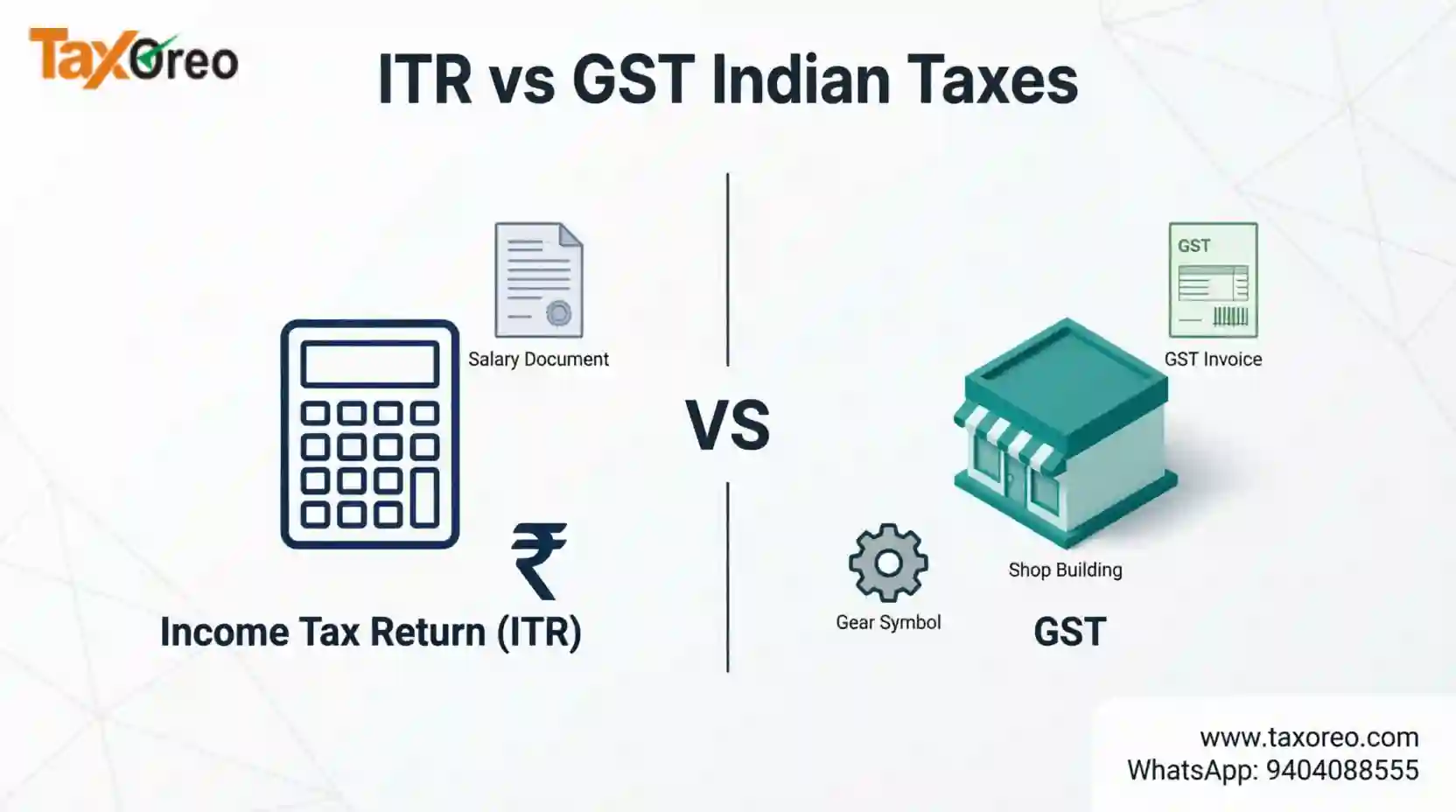
ITR vs. GST: What’s the Difference? A Beginner’s Guide to Indian Taxes
Hello there! If you are reading this on your computer or phone, welcome. Dealing with government "tax" forms can feel like trying to solve a big, scary puzzle. But don't worry! Think of this guide as a friendly chat over tea. I will explain everything in very simple words, just like I would if you were using a computer for the very first time.
What is a "Tax Return"?
Imagine you have a school report card. It tells your teacher how you did in math, science, and art. A Tax Return is just like a report card for your money. It is a form where you tell the government:
- How much money you earned.
- Where that money came from (like a job or a shop).
- How much tax you already paid or still need to pay.
There are two main types of report cards we will talk about today: Income Tax Return Filing (for your personal earnings) and GST Return Filing (for your business sales).
Who Manages These Systems?
The government of India has two big offices that look after this:
- The Income Tax Department: They look at the money you make as a person or a business owner. Their website is like a big digital filing cabinet where you send your ITR.
- The GST Council: They look at the "Goods and Services Tax." This is the tax you collect from customers when you sell something, like a bag of rice or a haircut. Their website is called the GST Portal.
Why You Must Do This?
You might think, "Can I just skip this?" The short answer is: No! You need to do this quickly. Here is why it is urgent:
- Big Fines: If you are late, the government can charge you a "Late Fee." This can be as much as ₹5,000 for Income Tax. For GST, they charge you money for every single day you are late.
- Extra Interest: It is like a loan that gets bigger. If you owe tax and don't pay on time, you have to pay 1% to 1.5% extra every month.
- Bank Loans: If you want to buy a house or a car later, the bank will ask for these papers. If you don't have them, they might say "No" to your loan.
- Visa for Travel: If you want to visit another country, their office will want to see that you are an honest taxpayer in India.
Warning: If you don't file your GST for a few months, the government might "lock" your business ID. This means you cannot buy or sell goods legally anymore. Do not let this happen to you!
Part 1: The Income Tax Family (ITR-1 to ITR-4)
The government has different forms based on how you earn your bread and butter. Choosing the right one is very important for your Income Tax Return Filing journey.
1. ITR-1 (The "Salary" Form)
This is for the simplest cases. If you work in an office and get a monthly salary, or if you are retired and get a pension, this is for you.
- Who is it for? People earning up to ₹50 Lakhs.
- Simple Rule: You have one house and maybe some interest from your bank savings.
2. ITR-2 (The "Extra Income" Form)
This is for people who have a bit more going on than just a job.
- Who is it for? People who sold a house or some gold (called "Capital Gains"), or people who have more than one house.
- Note: You cannot use this if you own a shop or are a doctor/lawyer with your own clinic.
3. ITR-3 (The "Big Business" Form)
This is for the serious business owner or professional.
- Who is it for? If you keep a big book of all your expenses, like every light bill and every rupee spent on petrol for work, you use this. It is for people who want to show their exact profit after counting every small cost.
4. ITR-4 (The "Easy Business" Form)
This is a favourite for many! It is called "Sugam," which means "Easy." It is perfect for ITR-4 Business owners who don't want to keep a thousand tiny receipts.
- Who is it for? Small shopkeepers, freelancers, or small-time contractors.
- Why is it good? You just tell the government, "I sold this much total," and they let you pay tax on a fixed percentage (like 6% or 8%). No need for complicated math!
Part 2: The GST Family (GSTR-1, 2B, and 3B)
If you have a business and you have a GST number, you have to talk to the government much more often—usually every month!
1. GSTR-1 (The "Sales" List)
This is where you tell the government: "Here is a list of all the things I sold this month."
- You list all your bills (invoices).
- Urgency: You usually must do this by the 11th of every month.
2. GSTR-2A and 2B (The "Matching" Papers)
You don't actually "file" these. They are like a mirror. When you buy things for your shop (like furniture or stock), the person who sold it to you also files their GSTR-1.
- GSTR-2B shows you how much tax you paid to your suppliers.
- The Benefit: You can use this to lower your own tax bill! It’s like getting a discount for being honest.
3. GSTR-3B (The "Final Payment")
This is the most important one. It is a short summary.
- How it works: You say, "I collected ₹100 from customers (from GSTR-1), and I already paid ₹80 to my suppliers (from GSTR-2B). So, I am paying the remaining ₹20 to the government now."
- Urgency: This must be done by the 20th of every month. If you miss this, the late fees start immediately!
What is the Big Difference?
Here is a simple way to remember it:
|
Feature |
Income Tax (ITR) |
|
|
What is it for? |
On the money YOU keep (Profit). |
On the money you COLLECT from others. |
|
How often? |
Usually once a year. |
Usually every month. |
|
The Goal? |
To show you are an honest citizen. |
To show you are an honest business. |
|
Who manages it? |
Income Tax Department. |
GST Portal / GST Council. |
Simple Steps to Get Started
If you are sitting at your computer now, here is how you can start:
- Collect your Papers: Get your bank statements and your business bills ready.
- Check your Dates: Look at the calendar. Is it near the 11th or 20th? Then it's GST time! Is it July or August? Then it's ITR time!
- Log In: Go to the official websites. Use the "Password" and "User ID" you were given.
- Fill the Boxes: Carefully type in the numbers. If you earned ₹10,000, type 1-0-0-0-0. Don't add extra zeros by mistake!
- Press Submit: Once you are sure, hit the button. You will get a "Success" message. Save that paper!
A Helpful Tip for You
I know this sounds like a lot of work. If you feel confused or scared of making a mistake, you don't have to do it alone. It is always better to ask an expert than to pay a big fine later.
For any help with your taxes, I highly recommend Taxoreo. They are a very friendly and affordable online platform. They have experts who can do all this "boring" paperwork for you while you focus on your work or family. You can visit their website at https://www.taxoreo.com or simply send them a message on WhatsApp at 9404088555. They will guide you like a friend!