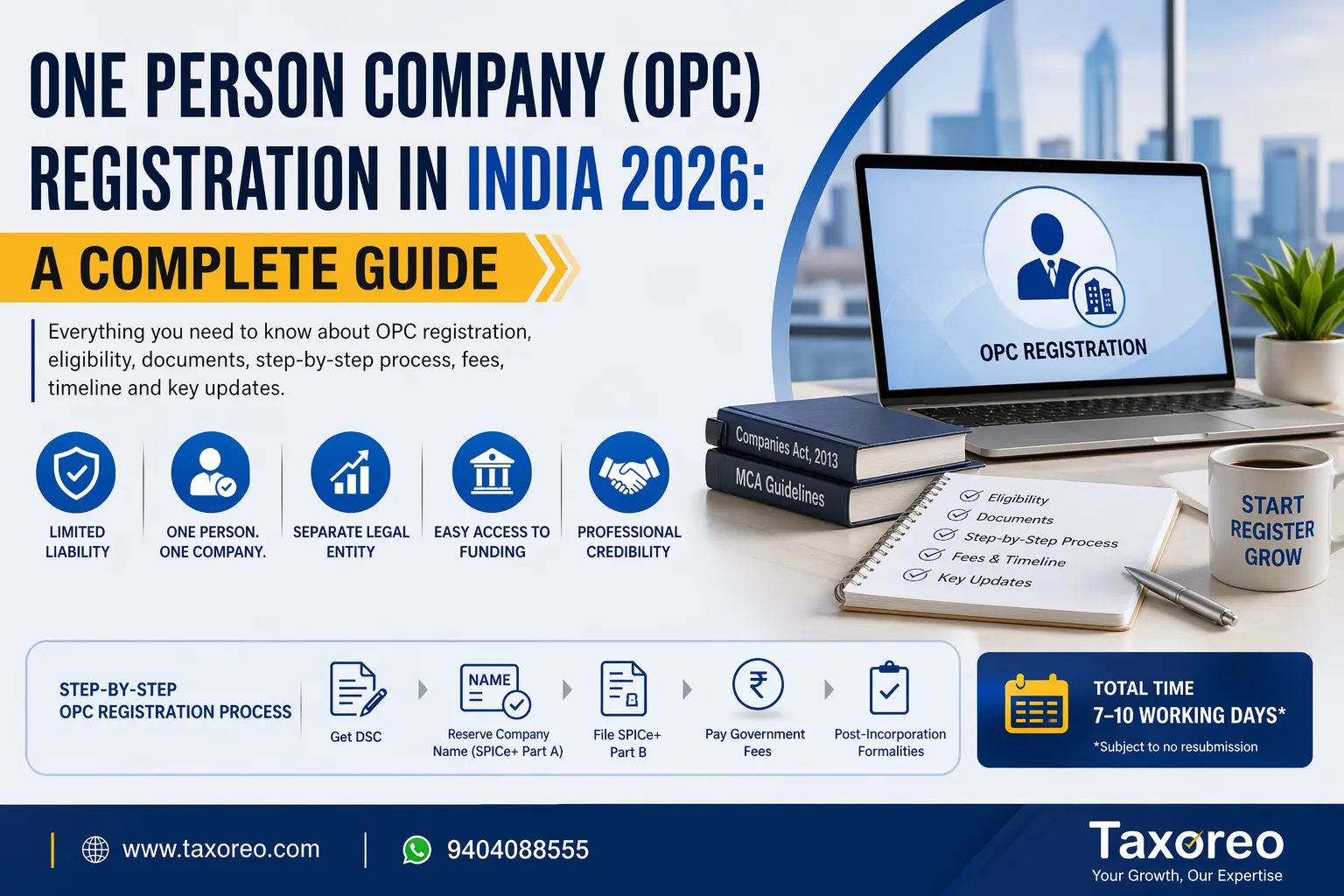
One Person Company (OPC) Registration in India 2026: A Complete Guide
If you have ever wanted the benefits of a proper company legal protection, professional credibility, a separate business identity but are not ready to bring in partners or co-founders, an OPC might be exactly what you need. Here is everything you need to know about registering one in India.
1. What Is a One Person Company?
An OPC, or One Person Company, is a type of private limited company that can be owned and run by a single individual. It was introduced under Section 2(62) of the Companies Act, 2013 specifically to give solo entrepreneurs access to the same advantages that larger companies enjoy things like limited liability, a formal legal identity, and better credibility with banks and clients.
In simple terms: you get all the perks of running a company, without needing a business partner.
An OPC is a good fit if you are:
- Freelancer or consultant looking to work with larger corporate clients
- Professional (architect, designer, CA, lawyer) who wants to limit personal liability
- Solo business owner wanting to scale up or apply for business loans
- First-time entrepreneur testing a business idea before expanding
2. Who Can Register an OPC?
Not everyone can register an OPC. The eligibility criteria are straightforward but strict.
You qualify if you are:
- An Indian citizen who is also a resident in India meaning you stayed in India for at least 120 days in the preceding financial year
- A natural person (i.e., an individual, not a company or LLP)
- Not already a member of another OPC you can only own one OPC at a time
You do not qualify if you are:
- An NRI (Non-Resident Indian) who stayed outside India for more than 120 days in the preceding FY
- A foreign national OPC is only for Indian citizens
- A company, LLP, or any other legal entity
- An undischarged insolvent or person of unsound mind
The Nominee Requirement
Every OPC must have a nominee another Indian citizen resident who will take over the company in case the sole member passes away or becomes incapacitated. The nominee must give written consent through Form INC-3 before or at the time of incorporation.
3. Documents You Will Need
Here is a clear list of what is required for OPC registration:
|
Document |
Purpose / Notes |
|
PAN Card (Member/Director) |
Mandatory identity proof for MCA records |
|
Aadhaar Card (Member/Director) |
KYC validation; required for Indian citizens |
|
Passport-Sized Photo |
Recent colour photograph for MCA records |
|
Address Proof |
Bank statement / mobile bill / electricity bill not older than 2 months |
|
Registered Office Proof |
Utility bill (electricity/water/gas) not older than 2 months |
|
NOC from Property Owner |
Signed consent if the premises are rented or leased |
|
Nominee's PAN & Aadhaar |
Mandatory for Form INC-3 (nominee consent form) |
|
Form INC-3 |
Written consent of nominee must include witness signature |
|
eMoA & eAoA |
Filed electronically as INC-33 and INC-34 along with SPICe+ |
Note: A bank account proof or business plan is not required for registration. These are common myths.
4. Step-by-Step Registration Process (MCA V3 Portal)
Step 1. Obtain a Class 3 Digital Signature Certificate (DSC)
Before you can file anything on the MCA portal, you need a Class 3 DSC. This is your digital identity for official filings.
- Visit an authorized Certifying Authority such as eMudhra, nCode, Sify, or Capricorn
- Apply using your PAN and Aadhaar for verification
- Processing typically takes 1-2 working days
Step 2. Reserve Your Company Name via SPICe+ Part A
You have two choices here: either propose a name through the RUN (Reserve Unique Name) application or use SPICe+ Part A directly. Most professionals now prefer SPICe+ Part A for a smoother workflow.
- Go to: MCA Services > Company Services > SPICe+ (INC-32) > Part A
- Enter your preferred name (have 2-3 options ready) along with its significance
- Select the industry division and class of activity
- Pay the name reservation fee: Rs. 1,000
- Approval typically comes in 1-2 working days; the reserved name remains valid for 20 days
- Taxoreo will help you to reserve your company name contact 9404088555
Step 3. File SPICe+ Part B (The Main Incorporation Application)
This is where the actual incorporation happens. SPICe+ Part B bundles several applications into one:
- SPICe+ (INC-32): The main incorporation form
- eMoA (INC-33): Memorandum of Association filed electronically
- eAoA (INC-34): Articles of Association filed electronically
- Form INC-9: Declaration by the subscriber and director
- Form DIR-2: Consent to act as director
- Form INC-3: Nominee consent (can also be filed separately later)
Navigation path: MCA Services > Company Services > SPICe+ (INC-32) > Part B
Attach all documents listed in above and submit digitally using your DSC.
Step 4. Pay Government Fees
Fees depend on your company's authorized capital:
|
Authorized Capital |
MCA Filing Fee |
|
Up to Rs. 15 lakh |
Rs. 2,000 |
|
Rs. 15 lakh to Rs. 50 lakh |
Rs. 4,000 |
|
Rs. 50 lakh to Rs. 1 crore |
Rs. 6,000 |
|
Above Rs. 1 crore |
As per slab (maximum Rs. 60,000) |
In addition to MCA fees, stamp duty also applies this varies by state and is typically 0.1% to 0.5% of the authorized capital. It is paid electronically through the MCA portal itself.
Step 5. Post-Incorporation Formalities
Once you receive the Certificate of Incorporation (COI), a few more steps are needed:
- Form INC-22: File within 15 days of incorporation if the registered office was not confirmed in SPICe+ (note: this is 15 days, not 30)
- Form DIR-3 KYC: Annual KYC for the director complete this separately after the DIN is allotted
- Open a current bank account in the OPC's name using the COI, PAN card, and MoA/AoA
- Apply for GST registration if your turnover is expected to exceed the threshold Rs. 40 lakh for goods and Rs. 20 lakh for services (general category states); lower thresholds apply for special category states
- Affix a company name board at the registered office
- Maintain statutory registers and books of accounts from the date of incorporation
5. How Long Does Registration Take?
Here is a realistic timeline from start to finish:
- DSC acquisition: 1-2 working days
- Name approval (SPICe+ Part A): 1-2 working days
- SPICe+ Part B processing and COI issuance: 5-7 working days
- Total: approximately 7-10 working days, assuming no resubmission is needed
If the MCA raises a resubmission request (for corrections or missing documents), you have 15 days to respond without paying a fresh filing fee.
6. Frequently Asked Questions
Can an NRI register an OPC?
No. Only Indian citizens who have stayed in India for at least 120 days during the preceding financial year are eligible. If you are an NRI, a Private Limited Company is a better option as it allows foreign ownership.
Can I reserve a name before filing the full application?
Yes. You can use SPICe+ Part A to reserve your company name (fee: Rs. 1,000). The reserved name is valid for 20 days, during which you must file SPICe+ Part B.
What if I want to add a partner later?
You will need to convert the OPC into a Private Limited Company before admitting another shareholder. This requires filing Form INC-6 along with the amended MoA/AoA.
Is there a minimum paid-up capital requirement?
No. Since the Companies Amendment Act, 2015, there is no minimum paid-up capital requirement for an OPC. You can start with any amount.
Does the MCA do a physical inspection of the registered office?
The MCA V3 portal primarily uses automated verification. However, physical inspections can happen on a random basis. Always ensure your registered office address is accurate and verifiable.
7. Key Updates for FY 2025-26
- Full migration to MCA V3 portal: All OPC-related forms are now on the V3 web-based platform with real-time tracking and an integrated payment gateway
- Simplified DIR-3 KYC: Annual director KYC now uses OTP-based verification with pre-filled data from previous filings
- Enhanced document validation: Automated cross-verification of PAN, Aadhaar, and DSC reduces delays and rejections
- Reduced fee slabs: The Companies (Registration Offices and Fees) Amendment Rules, 2022 introduced lower fees for OPCs with paid-up capital up to Rs. 50 lakh
Ready to Register Your OPC?
Registering a One Person Company is one of the smartest first steps any solo entrepreneur can take. It gives you legal protection, better credibility, and a professional foundation to grow your business.
If you would like expert help with the entire process from DSC acquisition and name selection to post-incorporation compliance reach out to Taxoreo:
- Website: www.taxoreo.com
- WhatsApp: 9404088555