Income Tax & TDS Compliance Calendar (FY 2026-27)
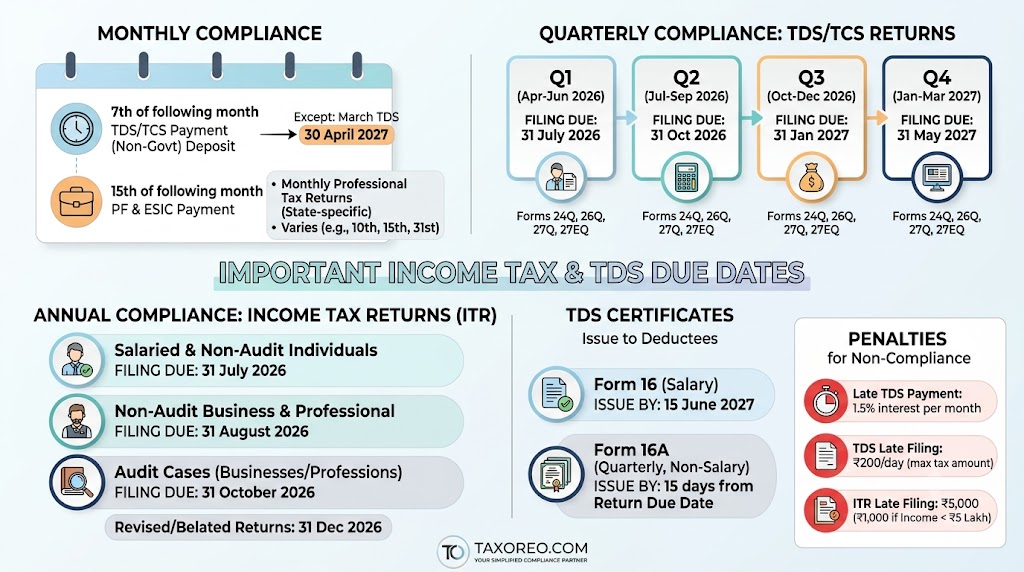
Running a business or managing finances in India means staying on top of a steady stream of deadlines from the Income Tax Department. To help you steer clear of sudden interest charges and late fees, here is a clear breakdown of the essential tax dates featured in our TaxOreo calendar.
1. Monthly Tasks You Can't Ignore
These are the routine compliance deadlines that roll around every single month:
-
7th of Every Month – TDS/TCS Deposits: If you deduct tax at source (TDS) or collect it (TCS), you must deposit it with the government by the 7th of the following month.
Note: There is a small breather for March—the TDS deducted in March can be deposited up until April 30th.
-
15th of Every Month – PF & ESIC: This is the hard deadline for depositing your employees' Provident Fund (PF) and Employee State Insurance (ESIC) contributions.
-
Professional Tax (PT) Returns: This deadline depends entirely on which state your business is registered in. Most states set this on the 10th, 15th, or the last day of the following month.
2. Quarterly Milestone: TDS/TCS Returns
Filing your TDS returns (Forms 24Q, 26Q, 27Q, and 27EQ) happens four times a year. Mark these dates down:
| Quarter | Period Covered | Filing Due Date |
| Quarter 1 (Q1) | April – June 2026 | 31 July 2026 |
| Quarter 2 (Q2) | July – September 2026 | 31 October 2026 |
| Quarter 3 (Q3) | October – December 2026 | 31 January 2027 |
| Quarter 4 (Q4) | January – March 2027 | 31 May 2027 |
3. Annual Target: Income Tax Returns (ITR)
Your final deadline for filing your yearly Income Tax Return depends on how your business or income is structured:
-
Salaried Individuals & Non-Audit Cases (31 July 2026): For everyday salaried employees, freelancers, and individuals who don't legally require a book audit.
-
Non-Audit Businesses & Professionals (31 August 2026): For small businesses or consultants who opt for presumptive taxation schemes (like ITR-4) and do not need an audit.
-
Audit Cases (31 October 2026): For corporations, firms, or partners whose accounts must be legally audited by a Chartered Accountant.
-
Revised or Belated Returns (31 December 2026): The absolute last chance to file a late return or fix mistakes from an earlier filing for this assessment year.
4. Giving Out TDS Certificates
Once your quarterly returns are in, you need to hand over tax certificates to the people you deducted tax from:
-
Form 16 (Salary): Must be given to employees by 15 June 2027.
-
Form 16A (Non-Salary): Must be issued within 15 days of filing your quarterly return.
⚠️ What Happens If You Miss a Deadline?
The Income Tax Department automatically applies penalties if you miss these dates:
-
Late Payment Interest: If you deduct TDS but don't deposit it on time, you'll owe 1.5% interest per month (or part of a month), calculated right from the day it was deducted.
-
Late Filing Fees (Section 234E): Missing a TDS return filing costs a flat ₹200 per day until you submit it (though the fee won't exceed the total tax amount due).
-
Late ITR Fees (Section 234F): Missing the annual return deadline brings a standard ₹5,000 late fee. (This drops to ₹1,000 if your total income is under ₹5 Lakh).
❓ Frequently Asked Questions
Q1: What is the actual difference between TDS and TCS?
Think of TDS as tax deducted while paying someone, and TCS as tax collected while charging someone.
-
TDS: You are the payer (like paying salary or rent), so you slice off a percentage and send it to the government on the payee’s behalf.
-
TCS: You are the seller dealing in specific goods (like scrap, liquor, or high-value cars), so you collect an extra percentage on top of the sale price from the buyer and pass it to the government.
Q2: How do I actually file a TDS/TCS return online?
It essentially comes down to four basic steps:
-
Fill it out: Use the government's Return Preparation Utility (RPU) or your own accounting software to add your deductee data.
-
Double-check it: Run that file through the File Validation Utility (FVU) tool to make sure there are no formatting blunders.
-
Get the file: If everything passes, the tool creates an
.fvufile. -
Upload it: Log into the Income Tax E-filing portal, head to the TDS section, upload the file, and verify it using an EVC code or your digital signature.
Q3: What if I miss the monthly 7th deadline for TDS?
You will be charged a 1.5% interest penalty per month. Keep in mind that this interest accumulates from the exact day you deducted the money, not from the day the deadline passed.
Q4: Is there a penalty for late TDS filings?
Yes, under Section 234E, it costs ₹200 for every single day the return stays unfiled. The only silver lining is that the total fine cannot be higher than the total TDS amount you collected for that quarter.
Q5: Can I get a refund on my TDS deductions?
Absolutely. If the total TDS cut from your income throughout the year turns out to be more than what you actually owe in taxes, you can get that money back. All you need to do is file your annual Income Tax Return (ITR). Once processed, the department will transfer the excess amount directly into your bank account.
Q6: How do I check if someone has actually deposited my TDS?
You can track this online quite easily using your PAN card:
-
Log into the official Income Tax E-filing portal.
-
Go to e-File > Income Tax Returns > View Form 26AS.
-
You can also pull up your Annual Information Statement (AIS) right from your dashboard to see real-time updates of taxes tied to your PAN.
Need a hand with your filings?
Don't let deadlines catch you off guard or risk dealing with tax notices. Let our team handle your data validation, challan matching, and return submissions smoothly.
👉 [Explore TaxOreo's Professional TDS & Compliance Services]